



For street lighting, CCTV and smart poles, the right choice is the arrangement that fits the site and can be installed, serviced and supported over time. This guide compares cylindrical solar panels vs flat solar panels through those practical project decisions.
What Are You Comparing: Module Shape or Mounting Arrangement?
Cylindrical, Hexagonal and Pole-Wrap Solar Modules
Cylindrical PV modules arrange photovoltaic surfaces around a shaft. Circular solar tubes use a curved profile; hexagonal solar panels for light poles use six flat faces around the pole. Other pole-wrap solar modules use different faceted or flexible constructions.
These pole-integrated solar panels use related integration approaches, not identical constructions. Shape alone does not establish cell technology, protective materials, electrical connections or output. For an overview, see Hinergy’s cylindrical solar panel design and selection guide.
Flat Solar Panels Can Be Tilted, Vertical or Horizontal
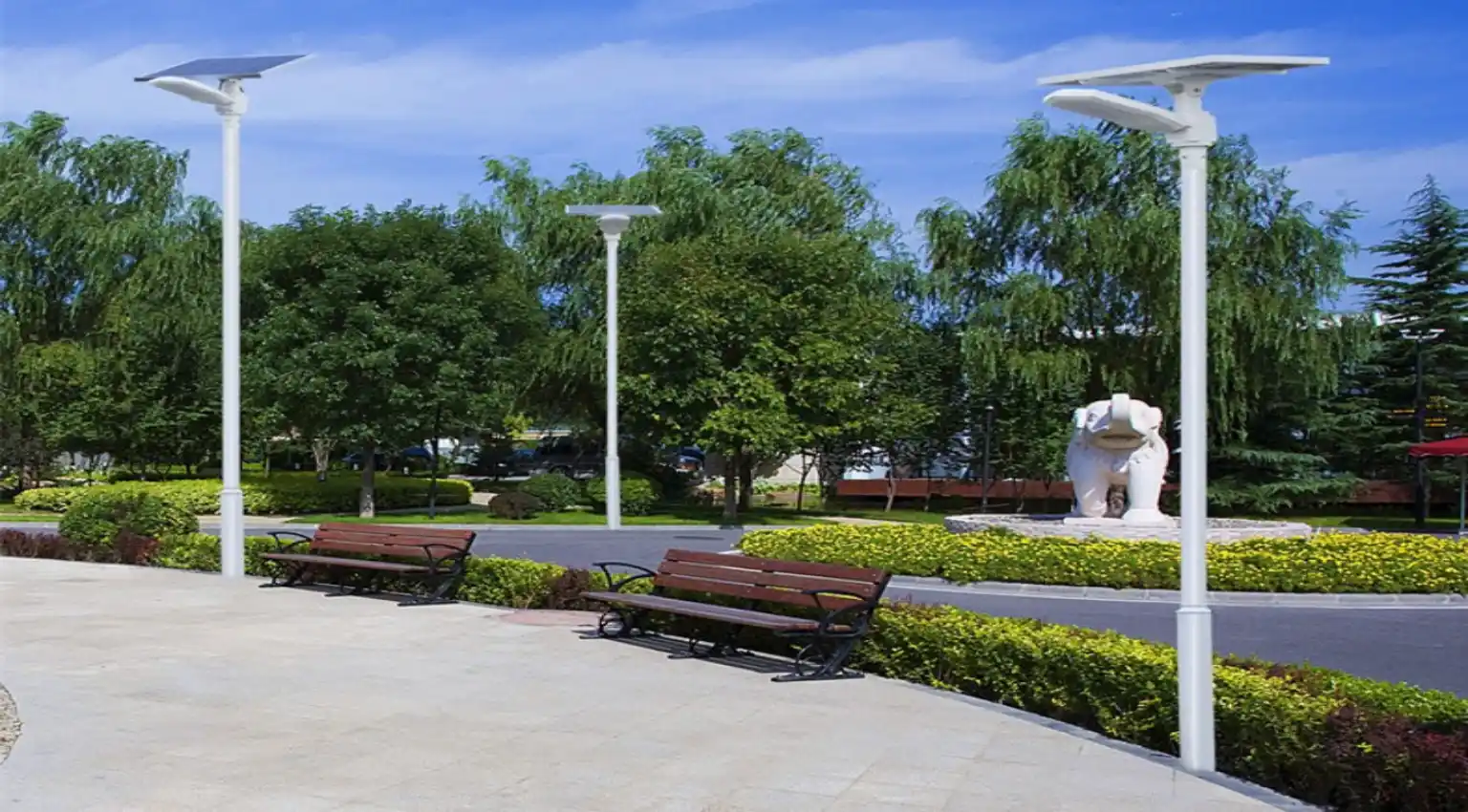
“Flat” describes the module’s planar surface, not its installed angle. Flat solar panel pole mounting may use a bracket that sets tilt and azimuth independently of the luminaire. A horizontal panel above a lamp is only one possible arrangement.
Similarly, all-in-one and split describe complete lighting-system architectures. They should not be treated as direct substitutes for module-shape categories. Compare the actual assembly drawings rather than relying on product names.
Cylindrical vs Flat Solar Panels: Project Comparison
Use the following table to identify trade-offs and the evidence needed before selecting either configuration.
Decision factor | Cylindrical / pole-integrated PV | Flat-panel PV | What to check |
|---|---|---|---|
Space and appearance | Keeps generating surfaces around the shaft; needs compatible dimensions and clearance | Uses a separate mounting surface or bracket, which may project away from the pole | Assembly dimensions and site layout |
Orientation and energy | Different surfaces receive different exposure; geometry and wiring affect output | Tilt and azimuth can be selected where mounting permits | Seasonal energy model and rating basis |
Shading | Pole equipment or nearby objects may shade individual sections | Array position, surroundings and electrical layout affect shading losses | Sun-path review and circuit arrangement |
Wind and weight | Changes the exposed profile but still adds weight and wind action | Panel, bracket and installation height affect loads on the pole | Complete structural assessment |
Installation | Check slide-on or split-shell assembly, taper and obstacles | Check clamp design, bracket locations and cable routes | Installation sequence and pole survey |
Cleaning and service | Vertical surfaces may limit some deposits; service access remains necessary | Requirements depend on tilt, local soiling and access | Cleaning method and access equipment |
Replacement | Specialized sections and mounting details may affect removal and spares | Replacement still requires electrical and mechanical compatibility | Spare-parts list and replacement steps |
Expansion | Available shaft height and compatible architecture constrain additions | Additional array area may be possible if the site and structure allow | Revised energy, controller and structural checks |
Project cost | Compare the complete configuration and planned service tasks | Apply the same supply, installation and operating boundaries | Comparable BOM and lifecycle assumptions |
The decision is project-specific. A compact outline is valuable where clearance or architectural requirements matter. Separately mounted panels offer different placement options. Neither advantage removes the need to check energy sufficiency and structural suitability.
Which Design Can Meet Your Daily and Seasonal Energy Needs?
Start with daily demand in watt-hours, including lighting schedules, cameras, communications and control equipment. Add the required battery backup and examine the periods when generation is lowest relative to demand.
For a meaningful cylindrical solar panel energy yield comparison, align:
Installation location, weather dataset and assessment period.
Required daily load, dimming schedule and days of autonomy.
Power-rating definitions and the complete electrical configuration.
Shading, temperature and other loss assumptions.
The measurement boundary, such as PV input or usable load-side energy.
Solar exposure depends on surface orientation and direct, diffuse and reflected radiation. Sandia’s PV Performance Modeling Collaborative describes these components in plane-of-array irradiance modeling. [1] A tilted flat panel and a module wrapped around a pole should therefore not receive the same exposure input without adjustment.
Cell interconnections and maximum power point trackers affect how differently illuminated sections operate together. Cylindrical-panel research also identifies geometry and electrical arrangement as important to output prediction; its preliminary results do not establish a universal yield advantage. [2]
Equal nameplate watts are not enough. For procurement, size each candidate configuration to the same service requirement, then compare the resulting equipment and cost. Our companion guide, How Much Energy Does a 100W Cylindrical Solar Panel Produce? explains daily energy calculations and load budgets in detail.
How Do Wind Loads, Pole Strength and Foundations Affect the Choice?
A solar module changes the loading on a pole. The panel, mounting hardware, installation height, lamp arm, equipment, pole and foundation form one structural system.
A pole-integrated module may reduce outward projection relative to a separate tilted array, but that does not establish a fixed wind-load reduction. Cylindrical solar panel wind resistance depends on the proposed dimensions, attachments and full assembly. Flat panels can also be used in an appropriately engineered system.
Request a project-specific assessment covering the relevant site conditions, module and bracket loads, pole capacity, connection details and foundation. An existing pole’s original rating may not include the proposed PV equipment.
The U.S. Department of Energy’s solar street-lighting guidance identifies added panel wind loading and its implications for poles and foundations. [3] It is a reason to assess the assembly, not to declare one geometry safe for every location.
For coastal and exposed sites, also review the specified materials, corrosion protection and fasteners. A generic module claim cannot replace verification of the proposed installation.
Which Option Fits Your Pole Space and Installation Access?
Pole-Integrated Solar Panel Mounting
Check pole diameter, taper, available shaft height, mounting tolerances and clearance around lamp arms, cameras, signs and access doors. A slide-on sleeve may require removal of equipment above it. A split assembly may have different fixing and service requirements.
For a cylindrical solar panel retrofit, confirm the actual installation sequence before ordering. Mechanical fit, structural capacity and electrical compatibility are separate checks.
Flat Solar Panel Pole Mounting
A separate bracket may allow PV orientation to differ from the direction of the light beam. Check bracket positions, the panel’s swept envelope, public-space clearances, cable protection and access for tightening or replacement.
A pole-mounted flat array may also place generation above or away from a local shading source where the structure permits. Conversely, an outward-projecting panel can conflict with nearby equipment or clearance limits.
When assessing solar panels for existing light poles, obtain drawings and a condition survey. Being able to attach a clamp does not establish that the pole and foundation are suitable for the added system.
Cleaning, Replacement and Service Access: What Changes?
Cylindrical solar panel maintenance should be planned around the actual installation height and construction. Vertical surfaces may retain less of some deposits than horizontal surfaces, but dust, bird fouling, seals, fasteners and electrical connections still need attention.
Flat solar panel cleaning also depends on tilt and local conditions. A tilted panel should not automatically be assigned the cleaning burden of a horizontal one.
Compare the practical service tasks:
Service question | Information needed from either supplier |
|---|---|
Can technicians reach the surfaces? | Access height, tools, working clearance and any lifting equipment |
How is a module removed? | Removal sequence, isolation procedure and protected handling method |
What happens to adjacent equipment? | Whether lamp arms, cameras or other parts must be moved |
Can a failed part be replaced? | Compatible spare sections, connectors, mounting parts and availability |
Maintenance convenience is more useful when described as an action than as a claim. Ask how the technician cleans, isolates and replaces the equipment, rather than accepting “maintenance-free” as a service plan.
Compare Installed and Lifecycle Costs, Not Only Price per Watt
A cylindrical vs flat solar panel cost comparison should use complete configurations that meet the same operating target. A lower module price does not establish a lower installed cost; a more integrated shape does not guarantee savings elsewhere.
Ask each supplier to identify whether its quotation includes:
PV modules, mounting assemblies and installation accessories.
Pole, lamp arm, foundation and anchor requirements.
Battery, controller, wiring and protection equipment.
Packaging, freight, handling and installation work.
Cleaning access, inspections and planned component replacement.
Separate supplied equipment from site work and exclusions. For lifecycle cost, use the same assessment period and consistent assumptions for labor, replacement, downtime and any discounting.
Potential structural or maintenance savings should be supported by drawings, quantities or a service plan. Do not assume they automatically offset a higher module price. Similarly, do not compare two quoted systems if one excludes the battery or foundation work included by the other.
Which Solar Panel Configuration Fits Your Pole Project?
Appearance-Constrained Streetscapes
For promenades, public spaces and architectural lighting, a cylindrical or hexagonal module may suit a requirement to keep PV close to the shaft. Confirm that the permitted module envelope can deliver the required energy and that maintenance access remains practical.
This is a useful starting point for solar panels for smart poles, where cameras, signs and communications equipment compete for space. Check their positions together rather than approving each accessory separately.
Open Sites with Greater Energy Demand
Where room and structure permit a separate array, flat panels may provide a practical route to selecting tilt, orientation and generating area. Evaluate this option for sustained lighting or combined monitoring loads requiring more collection capacity.
The result still depends on site exposure, structural requirements and available installation space. Additional panel area is not a substitute for a complete energy and storage check.
Existing Poles with Restricted Access
For an existing installation, begin with the pole survey and installation constraints. A wrap-around module may fit the desired outline but require access above the lamp arm. A separate bracket may avoid that assembly route but add projection or different structural loads.
If neither configuration passes the required checks, consider a new pole or a separately located PV assembly rather than forcing a retrofit. The preferred option is the one supported by the survey, energy assessment and installation plan.
What Should You Ask Before Requesting a Quotation?
Give suppliers a common brief so their recommendations can be compared. Include the installation city, operating hours, load data, required autonomy, pole drawings, equipment positions, shading, site exposure and maintenance constraints.
Request a configuration-level response with the proposed module, electrical ratings, mounting arrangement, battery/controller match, energy assumptions and supply exclusions. Ask which information is still missing before approval.
For cylindrical solar panels for street lights or monitoring equipment, browse Hinergy cylindrical solar panel models, then review the selected model against that brief. Product dimensions and power ratings are starting points for selection, not proof of site suitability.
FAQs: Cylindrical Solar Panels vs Flat Solar Panels
Are cylindrical solar panels more efficient than flat panels?
Not automatically. Cell efficiency, module rating and installed energy yield describe different things. Compare the selected products under consistent rating and site conditions, including electrical losses. An integration benefit does not by itself establish higher energy production.
Is a flat solar panel the same as a horizontal panel?
Do cylindrical solar panels work better in winter or cloudy weather?
Which solar panel design is better for windy pole locations?
Can either configuration be added to an existing light pole?
Are pole-wrap solar modules maintenance-free?
Is solar wrap vs flat solar panel cost mainly a price-per-watt decision?
Which option fits street lights, CCTV and smart poles?