



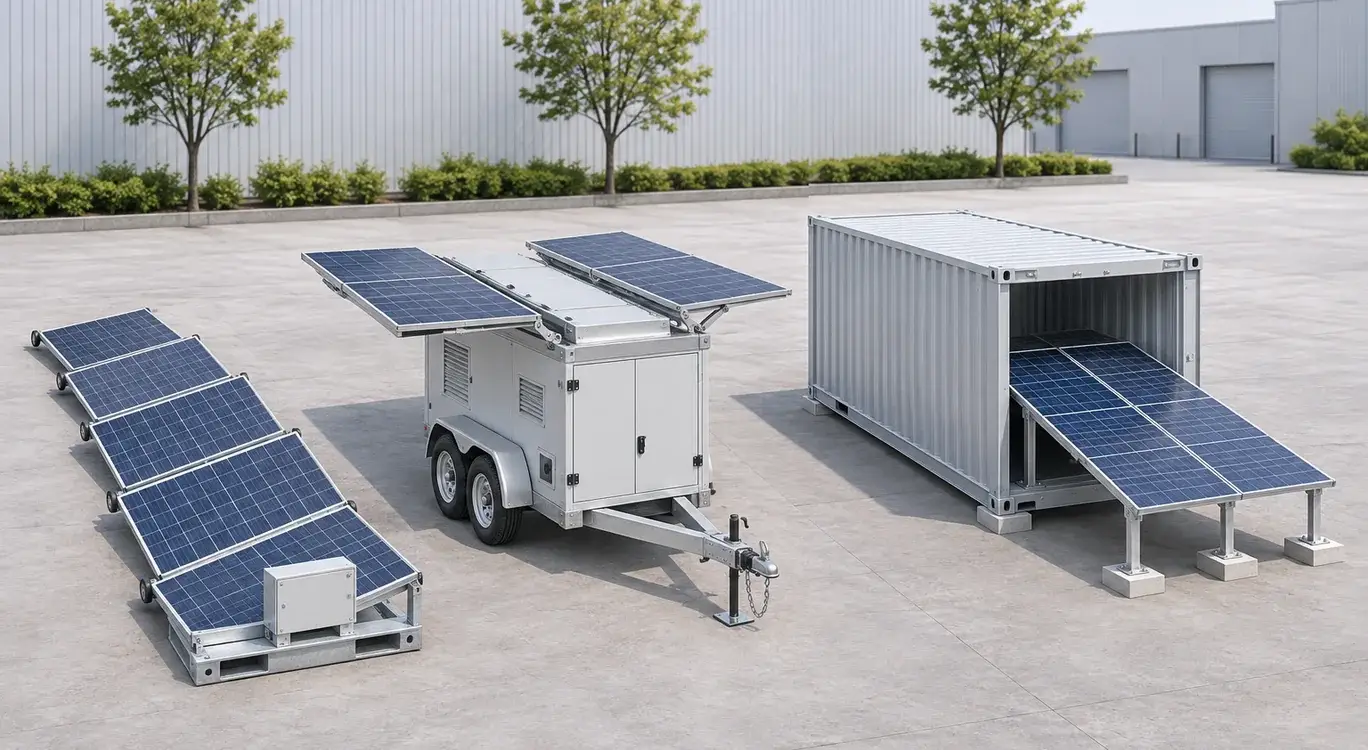
Illustration of a pallet-based array, a solar power trailer and a solar container.
Fold-Out Solar Array vs. Trailer vs. Container at a Glance
Start with the transport plan and the required electrical output. Evaluate each on its own. A trailer or container can have a folding array, and a fold-out array can be supplied alongside separate power equipment. In this guide, fold-out solar array refers to a pallet-based unit that opens along the ground.
Decision | Pallet-based fold-out solar array | Solar power trailer | Solar container |
|---|---|---|---|
How it travels | Folded on a handling base, carried on suitable freight equipment | Towed on its own chassis by a compatible vehicle | Transported as a container by suitable freight equipment |
What happens on site | The crew unloads the base and opens the hinged PV sections on prepared ground | The trailer is positioned and secured. The array may stay fixed or open from the chassis | The container is set in place. PV may retract into it, unfold from it or mount on an external structure |
Space to allow | Full array length and width, unloading area and access for retrieval | Parking and maneuvering space, plus clearance for any deployed panels or supports | Delivery and set-down area, door access and space for the deployed array |
Electrical scope | Solar DC output for a compatible power system. Inverter and storage can be quoted separately | May provide solar input alone or usable AC power with onboard equipment | May package PV with conversion and storage, or pair with separate equipment |
What makes a move practical | A suitable carrier and handling equipment at both sites | A compatible tow vehicle, accessible route and a trailer approved for the intended use | Container handling at both ends and room to close or dismantle the external equipment |
How Each Mobile Solar Format Is Built
Pallet-Based Fold-Out Solar Array
A mobile fold-out solar array system packages rigid hinged PV modules, a deployment mechanism and a handling base. The folded assembly travels as cargo. After unloading, the crew extends the modules over prepared ground and hands off the array's DC connection to the power system. A forklift-ready base helps when suitable handling equipment is already part of the site's routine.
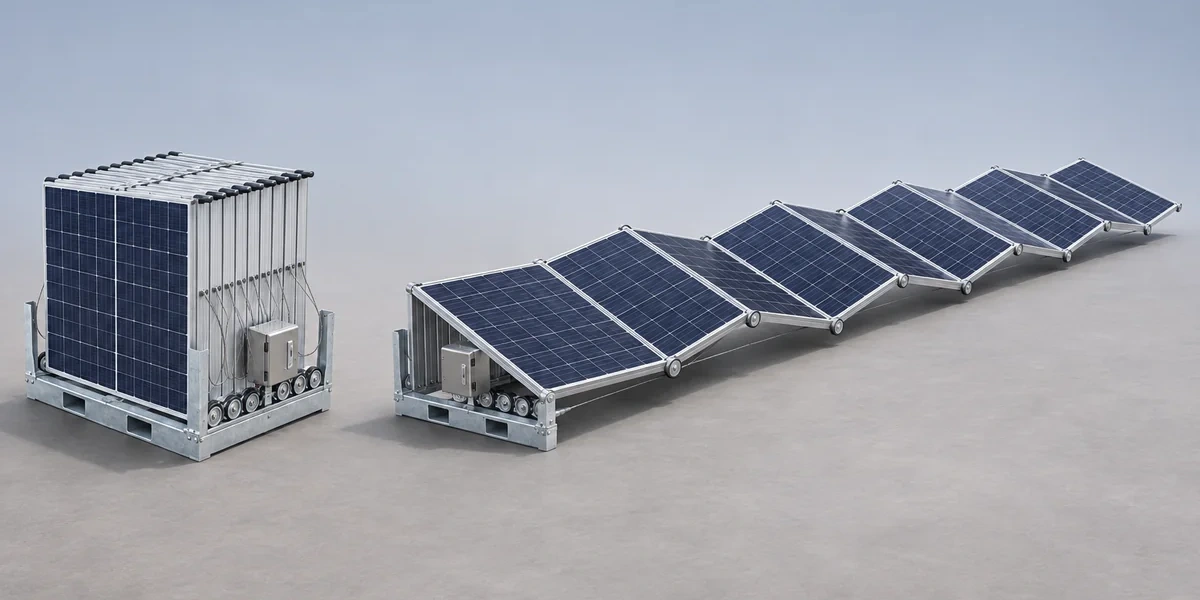
Illustration of the stowed and ground-deployed configurations of a pallet-based array.
This approach can add solar generation to an existing off-grid system if its PV input and controls suit the array. Factory-prefabricated ground-mount blocks show why it helps to separate shipping method from operating layout. Some are shipped in containers or on flatbeds, then deployed as ground arrays at the destination. 5B Maverick ground-mount example.
Towable Solar Power Trailer
A solar generator trailer carries equipment on a towable chassis. An integrated off-grid solar trailer may include PV, batteries and an inverter so it can supply specified AC loads at the site. Solar-only trailers also exist and can feed a compatible external system. If you need general-purpose power, ask for the outlet types, continuous AC output and surge rating. A solar lighting trailer is generally configured around its lights. Example of a solar-only trailer.
For a unit that will move regularly, confirm the loaded trailer weight and the tow vehicle, hitch and braking requirements. Ask how the panels are secured for transport and what the crew needs to do before the trailer can move again.
Containerized Solar Power System
A solar container uses the container as part of the equipment package. Some designs house a retractable folding rack that rolls out at the site. Others carry equipment and PV modules that the crew mounts separately. Integrated energy storage, external energy storage and generator backup are configuration choices. Ask the supplier to show where each component sits during transport and operation. Retractable PV example reported by pv magazine.
Check the Deployed Footprint and Access Route
Put the transport configuration and the deployed layout on the same site drawing. A compact shipment can open into a long array. You need to know how the equipment gets off the vehicle, where it opens and how it will be retrieved when the job ends.
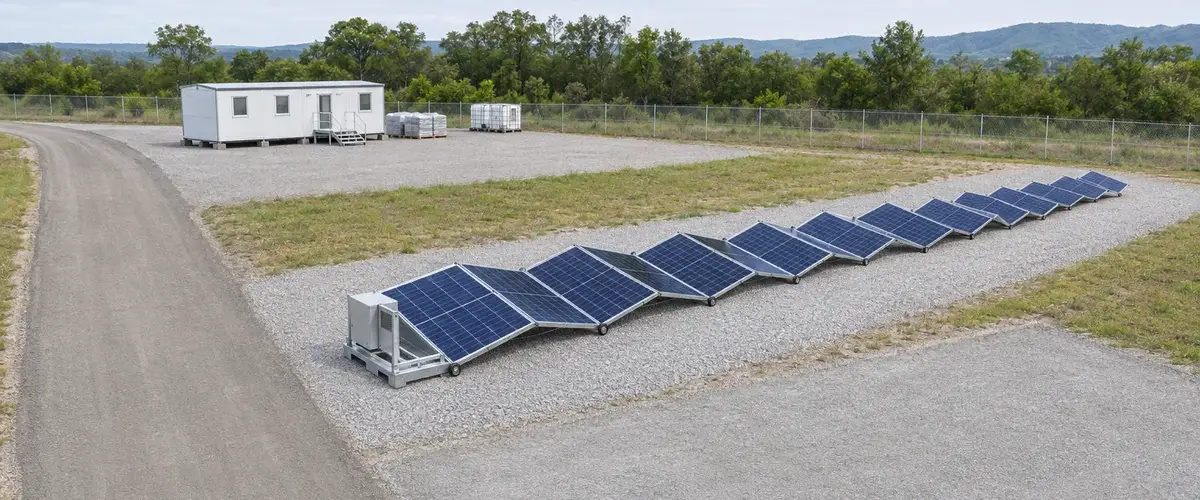
Illustrative jobsite layout with a deployment strip, access road and open staging area.
Access route. Check the delivery vehicle's approach, turning and exit space. Confirm the transport weight, loaded dimensions and handling method with the supplier.
Deployment area. Mark the array's full deployed footprint, the direction in which it opens and the space needed for unloading or positioning. Keep access to the equipment and the site's working routes available.
Site conditions. Request the model-specific limits for the surface, slope, restraint and weather conditions in which the unit can be deployed, operated and stowed.
Time to usable power. Ask which tasks the stated deployment time covers. Compare the full sequence from arrival through handling, unfolding, electrical checks and commissioning. For redeployable solar, ask about expected deployment cycles, stowage and inspections between moves.
Prefabrication can shift work from the field to the factory. The value on a temporary project depends on the equipment and crew available for each deployment. PV Tech's comparison of pre-assembled PV approaches.
Compare PV, Inverter and Battery Ratings Separately
Two mobile solar quotes can list the same number of kilowatts and deliver different services. Read the unit and the equipment it applies to.
Quoted figure | What it describes | What to confirm |
|---|---|---|
PV array power, kW DC | Nominal solar generation capacity | Expected energy in kWh for the location and season, plus compatible PV inputs |
Inverter output, kW AC | Power the inverter can supply to AC loads | Continuous and short-duration output, voltage, phase and frequency |
Usable battery energy, kWh | Energy available from storage within stated limits | Usable capacity, discharge power, reserve and how the battery will recharge |
Example. A site office averaging 1.5 kW for eight hours uses 12 kWh. A 0.2 kW communications load running for 24 hours uses another 4.8 kWh. The total is 16.8 kWh per day at the load, including 3.2 kWh for communications during the other 16 hours. For an overnight storage estimate, account for conversion losses, reserve and any other loads on the same supply. For inverter sizing, also check simultaneous loads and equipment startup demand.
If the job needs power through periods of low solar production, specify battery autonomy and the available charging or backup source. For a solar-plus-storage project, share your load schedule and existing equipment when you review Hinergy off-grid solar system options.
Choose a Format for Your Project
Temporary Construction Power With Existing Equipment
A contractor planning off-grid construction power may already have an inverter and a battery energy storage system (BESS) and need more PV input at the jobsite. A pallet-based fold-out array is worth evaluating when the site has room for the ground strip and equipment to unload and retrieve it. Start with the available space and the receiving equipment's PV input limits.
Emergency Response With Frequent Dispatch
A team needs mobile renewable backup power for communications and a charging station at different sites. A solar emergency response trailer can fit that deployment pattern if a tow vehicle is available and the quoted battery and AC outputs cover the priority loads. One reported mobile nanogrid for Santa Barbara County combined PV, batteries and fuel-cell backup. The California Energy Commission also documents field testing of a solar-plus-battery trailer in several climate zones. Santa Barbara County case. California Energy Commission field study.
Remote Camp With Planned Container Delivery
A remote camp already receives freight by container and can stage and unload it on site. A containerized solar power system may suit that logistics plan. Compare the open array footprint with the available ground and confirm whether batteries, power conversion and remote monitoring are integrated or delivered separately.
What to Include in a Mobile Solar RFQ
Give each supplier the same information and ask for an itemized quote.
Site and moves. Location, months of use, expected moves, access sketch, available unloading equipment and clear space for the array.
Load profile. Peak and continuous demand, equipment startup loads, daily kWh, overnight loads and any critical loads that need backup.
Electrical interface. Required output voltage, phase and frequency, or the make, model and PV input limits of your existing inverter or BESS.
Equipment and services. Ask what is included for PV, inverter, storage, backup, monitoring, handling, on-site connection, commissioning and training.
Time and cost. Ask for the closed and open drawings, crew and equipment requirements, setup and pack-down time, and estimated freight and handling for the first move and later moves.
Compare delivered cost and the work your team has to do after delivery. A solar-only quote and a complete AC power package can both be valid, but your cost comparison needs to include the rest of the equipment and services required to power the same loads.
Frequently Asked Questions
Can a solar container also be a fold-out solar system?
Yes. A container can house a folding or retractable array that opens onto the ground. Check whether the container is part of the operating equipment and whether the PV is attached, deployed on a rail or set up separately.
Which mobile solar format is easiest to relocate?
Can a mobile solar setup run at night?
Can I use a fold-out solar array with an existing BESS?