



A search for cylindrical solar panel cost can return a solar sleeve, a two-module pack or a complete lighting pole. Those are different purchases. Even two products labeled 100W may have different constructions, electrical arrangements and rating methods.
This guide explains how to compare a cylindrical solar panel quotation for street lights, CCTV and smart poles. It focuses on procurement decisions rather than publishing an unsupported universal price list. For the broader product overview, use Hinergy’s cylindrical solar panel design and selection guide.
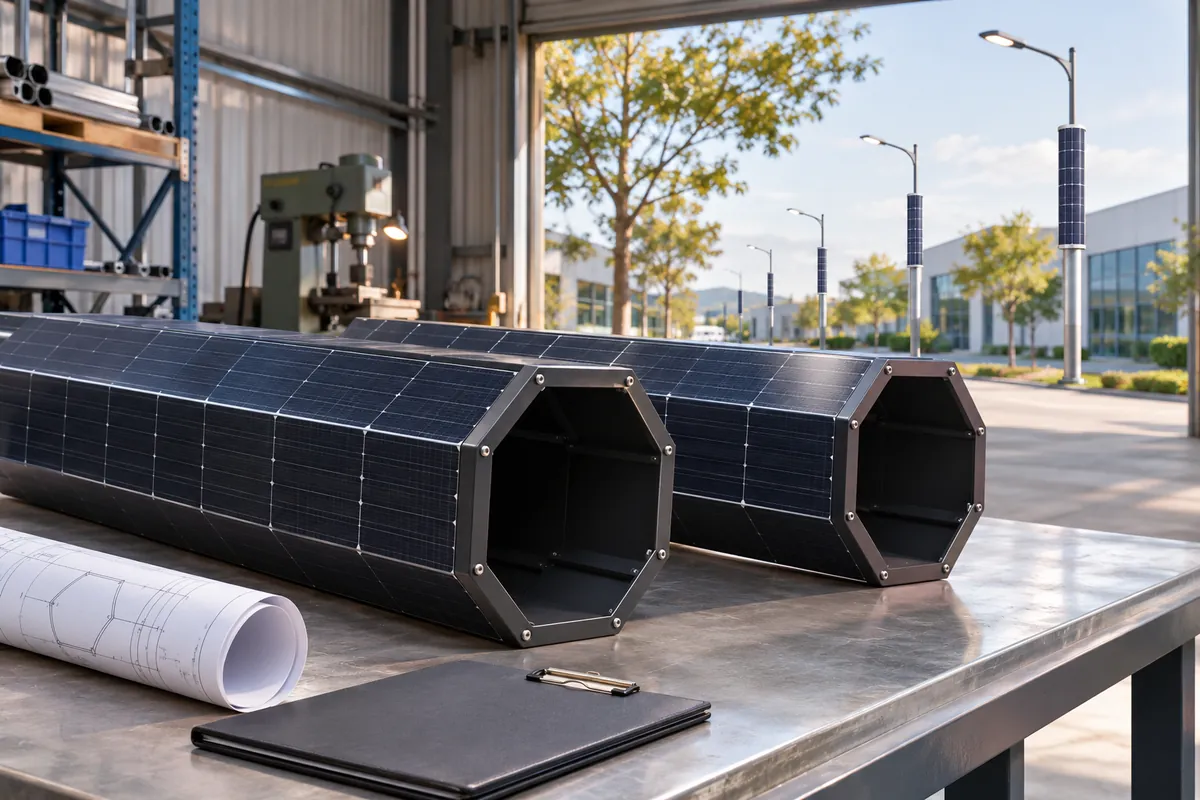
How Much Does a Cylindrical Solar Panel Cost?
There is no single price that covers every cylindrical PV module. A useful offer identifies what is being sold, how its electrical output is rated, how it mounts and where the supplier’s responsibility ends. A sample price, a wholesale cylindrical solar panel price and an installed smart-pole budget represent different commercial scopes.
For a 100W cylindrical solar panel price, ask for the exact model and the number of modules included. Confirm whether 100W refers to one assembled sleeve, one section or the combined rating of multiple sections. A product photograph or the phrase “360-degree charging” does not establish an equivalent test basis or daily energy yield.
The fastest route to a meaningful number is a defined RFQ, not a wattage-only inquiry. Send a drawing, quantity and supply boundary, then ask the supplier to identify assumptions and exclusions alongside the price.
First Define What the Cylindrical Solar Panel Quotation Includes
Before comparing prices, separate the photovoltaic component from the power system and the installed pole. Use the same boundary in every request.
Purchase scope | Items to identify | Common exclusions to confirm |
|---|---|---|
Module only | Solar sleeve, specified cable, connectors and module documentation | Mounting kit, battery, controller, pole and lamp |
Module with mounting kit | Module plus listed clamps, collars, brackets and fasteners | Pole suitability review, installation and power electronics |
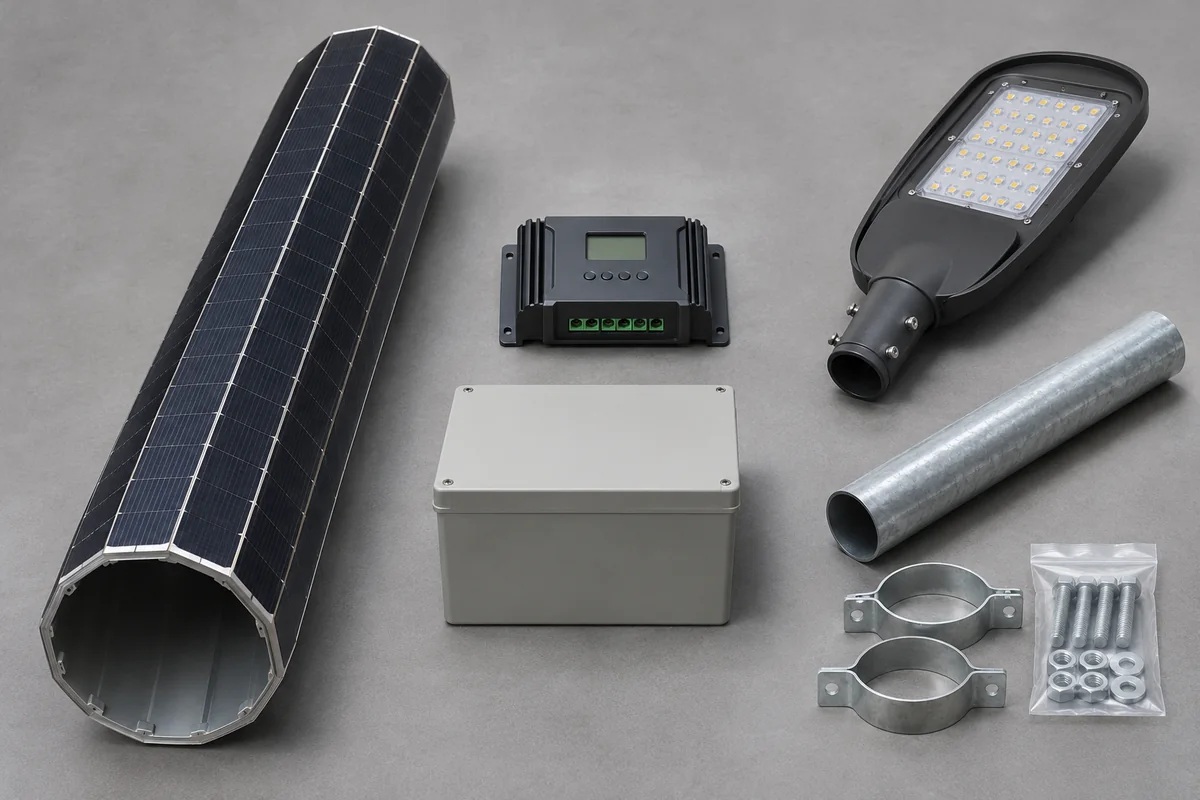
Pole power package | Defined PV modules, battery, controller, enclosures and wiring scope | CCTV camera, router, luminaire, pole and commissioning unless listed |
Complete pole equipment | Explicit equipment list, pole, mounting parts and agreed engineering deliverables | Foundations, civil works, permits and local labor unless included |
Installed project | Equipment plus contracted transport, site works, installation and acceptance scope | Any remaining owner-supplied work and operating costs |
Ask whether the quoted unit is a piece, pair, sleeve assembly, kit or complete set. If a complete system already includes a battery or mounting hardware, do not add those components again when totaling the quotation.
What Affects the Price of a Cylindrical Solar Panel?
Module Construction and Protective Materials
A hexagonal solar panel price, circular solar tube price and flexible solar pole-wrap price may reflect different bills of materials. Flat rigid faces, curved glass and flexible laminates involve different fabrication and assembly requirements. Similar outside shapes do not prove identical cell technology or durability.
Request the selected model’s cell type, protective glass or laminate, encapsulation, frame, end caps and sealing details. Specify the documented construction you need rather than assuming one shape is always cheaper or more reliable.
Rated Power and Electrical Configuration
More active cell area can change material use, sleeve length and handling requirements. Voltage, current, series connections, bypass arrangements and cable routing can also change the configuration. Two modules with the same advertised watts are not interchangeable simply because both wrap around a pole.
Request Pmax, Vmp, Imp, Voc and Isc with test conditions and tolerances. For a multi-face module, ask how the declared power was established and how the faces are interconnected. A sum of section ratings must not be treated as guaranteed simultaneous operating power on an installed pole.
Dimensions, Pole Fit and Mounting Hardware
A cylindrical solar panel for light poles must fit the actual mounting location. Check available height, pole taper, outside diameter, obstructions and cable access. The module’s outside diameter or across-flats dimension is not automatically its acceptable pole diameter.
A custom collar, split mounting arrangement or revised cable exit can require extra design work and parts. Confirm the drawing revision and installation method before comparing unit prices. For dimension terminology and electrical fields, see the hexagonal solar panel specifications guide.
Quantity, Samples and Custom Engineering
Cylindrical solar panel wholesale pricing depends on the defined batch, not just annual purchase intentions. Prototype work, setup, special components, tooling and inspection can be spread across different quantities. A sample sent by express courier is not a reliable predictor of a production order’s delivered unit cost.
Ask suppliers to separate recurring production charges from non-recurring engineering, tooling and sample charges. Request pricing at your realistic pilot and production quantities. Confirm MOQ per model, revision or finish, plus whether tooling ownership, sample credit or repeat-order terms are included in the offer.
Inspection, Documentation and Warranty Scope
A quotation may include routine production checks, while a tender calls for additional reports, traceability or third-party inspection. List the documents and acceptance criteria required for the exact model. Confirm whether existing reports apply or new testing is proposed, and price any additional work separately.
Read warranty terms beyond the duration. Identify covered components, exclusions, claim evidence, replacement freight and site labor responsibilities. Do not assume that a long module warranty also covers batteries, controllers, installation or lost CCTV operation.
Packaging, Transport and Delivery Schedule
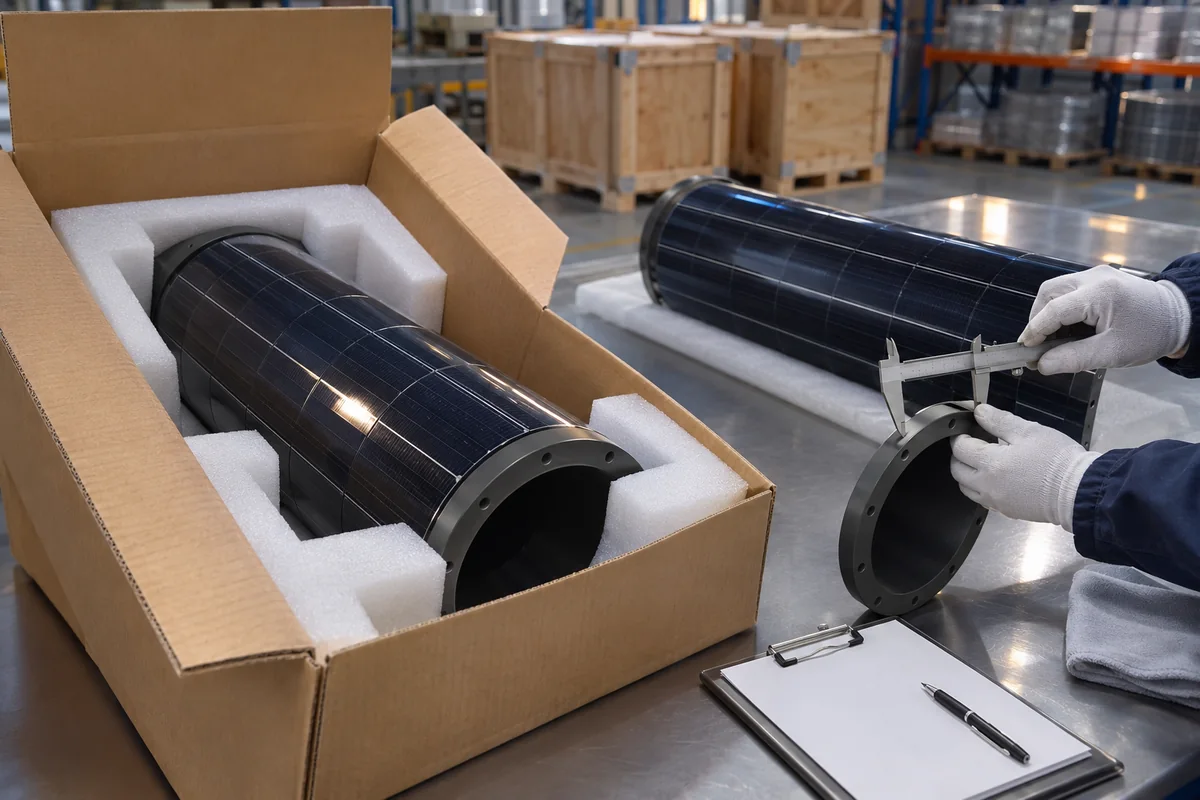
Long sleeves and protective packaging can create a shipment with substantial volume relative to its power rating. Carton dimensions, gross weight, handling protection and shipment size affect the delivered cost. Ask for a packing list and route-specific freight estimate rather than estimating transport from module watts.
An urgent delivery may also change component sourcing, shipment method or production scheduling. Confirm when lead time begins: drawing approval, deposit receipt, sample acceptance or another agreed milestone. Record quote validity and freight validity separately when they differ.
Is Price per Watt a Fair Way to Compare Solar Sleeves?
Price per watt can be a secondary comparison metric after the power definition and supply scope match. It is not a substitute for checking fit, electrical compatibility and what is included.
Module-only price per rated watt = comparable module-only price ÷ declared module rated power.
Use the same currency, quantity and rating basis. Keep battery, pole, installation and freight charges outside a module-only comparison. If one offer includes clamps and another does not, normalize the hardware scope before treating the result as equivalent.
For an operating system, ask a different question: what equipment meets the required load and seasonal reserve at this site? Energy yield depends on exposure and installation geometry, not only nameplate watts.[1] Review the 100W cylindrical solar panel energy-output guide before converting a module label into expected daily energy.
Worked Example: The Lower Module Price Can Produce a Higher Subtotal
The following numbers are entirely hypothetical. They demonstrate quote comparison, not current market prices, Hinergy selling prices or a forecast of project savings.
Assume both offers cover 100 modules with an equivalent verified specification, identical required mounting and packing protection, and freight to the same named destination terminal. Assume both exclude destination terminal charges, import clearance, duties, taxes and onward local delivery. Batteries, controllers, poles, installation and other project costs are also outside this example.
Comparable supply line | Offer A | Offer B |
|---|---|---|
100 modules | 100 × USD 180 = USD 18,000 | 100 × USD 210 = USD 21,000 |
Required mounting and protective packing | 100 × USD 35 = USD 3,500 | Included in module line |
One-time setup charge | USD 500 | No separate charge |
Freight to the same destination terminal | USD 2,000 | USD 1,600 |
Evaluated supply subtotal | USD 24,000 | USD 22,600 |
Subtotal allocated per module | USD 240 | USD 226 |
Offer A begins with the lower module unit price but produces a USD 1,400 higher subtotal after the stated additions. This result does not establish better quality or lower lifetime cost for Offer B. It only shows why scope normalization matters.
Replace every amount with written quotations. Verify technical equivalence first, then use the actual delivery terms to establish which remaining costs belong to the buyer. Do not label this subtotal a complete landed cost or installed cost.
Separate Module Price from Street-Light and CCTV System Cost
For cylindrical solar panels for street lights, the lighting schedule, required illumination, seasonal solar resource and battery reserve affect the surrounding system. A smaller PV purchase price can be offset by a configuration that fails the operating requirement. Conversely, an unnecessarily large system can create avoidable cost.
For CCTV and smart poles, include the camera’s day/night profile, router, PoE equipment, sensors and any lighting. Continuous communications loads and recovery after poor weather can materially change the battery and PV requirement. Use the CCTV and smart-pole power-sizing guide for that calculation rather than selecting the cheapest sleeve first.
Existing poles create another cost boundary. Reuse can avoid some new equipment purchases, but inspection, mounting adaptation, cable work and structural review may still be necessary. See adding cylindrical solar panels to existing light poles before assuming a retrofit needs only a solar module.
Compare Delivery Terms, Not Just the Quoted Currency
A factory price, an export-port price and a destination-delivery price do not represent the same responsibilities. Ask for the chosen Incoterms rule, its named place or port and the applicable version. ICC’s guidance emphasizes the importance of identifying that location clearly.[2]
Keep freight, insurance, customs clearance, taxes and local delivery visible in the commercial comparison. A quotation that includes carriage to a destination does not necessarily transfer transport risk there; ICC distinguishes these concepts under its C and D rules.[3] Confirm the specific arrangement rather than interpreting “shipping included” as a complete door-to-door commitment.
For budgeting, use separate totals for equipment, the delivered supply scope and installed works. Add only costs outside the quoted scope, avoiding double counting. Confirm destination charges with the relevant logistics and import parties; this article does not estimate local duty or tax rates.
How to Reduce Cost Without Weakening the Approved Specification
Start with design clarity. A stable pole drawing, agreed power basis and approved cable arrangement can reduce repeated revisions. Where suitable, select an existing documented module configuration rather than requesting new geometry solely for appearance.
Consolidate genuinely compatible quantities, confirm packaging before freight booking and distinguish essential requirements from optional finishes or services. Ask for separately priced alternatives with clear technical deviations. Keep the selected construction, acceptance criteria and warranty responsibilities visible in the final order.
A cylindrical-versus-flat comparison may also reveal an architectural choice, rather than a supplier-price problem. Compare both options against the same loads, site exposure and structural requirements using the cylindrical and flat solar panel comparison. Do not assume either shape automatically delivers the lowest installed cost.
What Should You Send for a Cylindrical Solar Panel Quotation?
Use the following checklist for a module-only inquiry or a wider solar pole project. Mark unknowns explicitly so the supplier can separate assumptions from confirmed requirements.
RFQ input | What to provide |
|---|---|
Application and location | Street lighting, CCTV or smart pole; project city and site exposure |
Supply boundary | Module only, mounting kit, power package or complete equipment scope |
Quantity | Sample, pilot batch and production quantity; number of models |
Electrical requirement | Required power-rating basis, voltage/current limits and controller details if selected |
Pole drawing | Diameter or profile at mounting height, taper, available length and access points |
Mechanical interfaces | Proposed mounting method, cable exits, finish and handling constraints |
Operating target | Load schedule and reserve requirement when system sizing is requested |
Documents and acceptance | Datasheets, drawing revision, applicable reports and inspection deliverables |
Commercial basis | Currency, requested delivery rule and named place, schedule and packing requirements |
Service scope | Warranty expectations, spare parts and responsibility for replacement work |
Copy-ready inquiry: Please quote [quantity] cylindrical solar modules for [application] in [location]. The required supply scope is [scope]. Attached are pole drawing [revision] and electrical requirements [details]. Please identify the model and rating basis, mounting parts, exclusions, one-time charges, packing dimensions, delivery terms, lead time and quote validity. List technical deviations separately.
FAQs About Cylindrical Solar Panel Price
What affects a 100W cylindrical solar panel price?
Construction, rating basis, pole fit, hardware, order quantity, customization and delivery scope can all affect the offer. First confirm whether 100W describes a complete module or several sections. Then request the price for the exact model, included parts and quantity.
Is a hexagonal solar panel cheaper than a circular solar tube?
Does a cylindrical solar panel quotation include the pole and battery?
Can I use a wholesale price to estimate a sample order?
How can I compare cylindrical solar panel cost with flat panels?
Does a longer warranty guarantee a lower lifetime cost?
What is needed for a custom cylindrical solar panel price?