



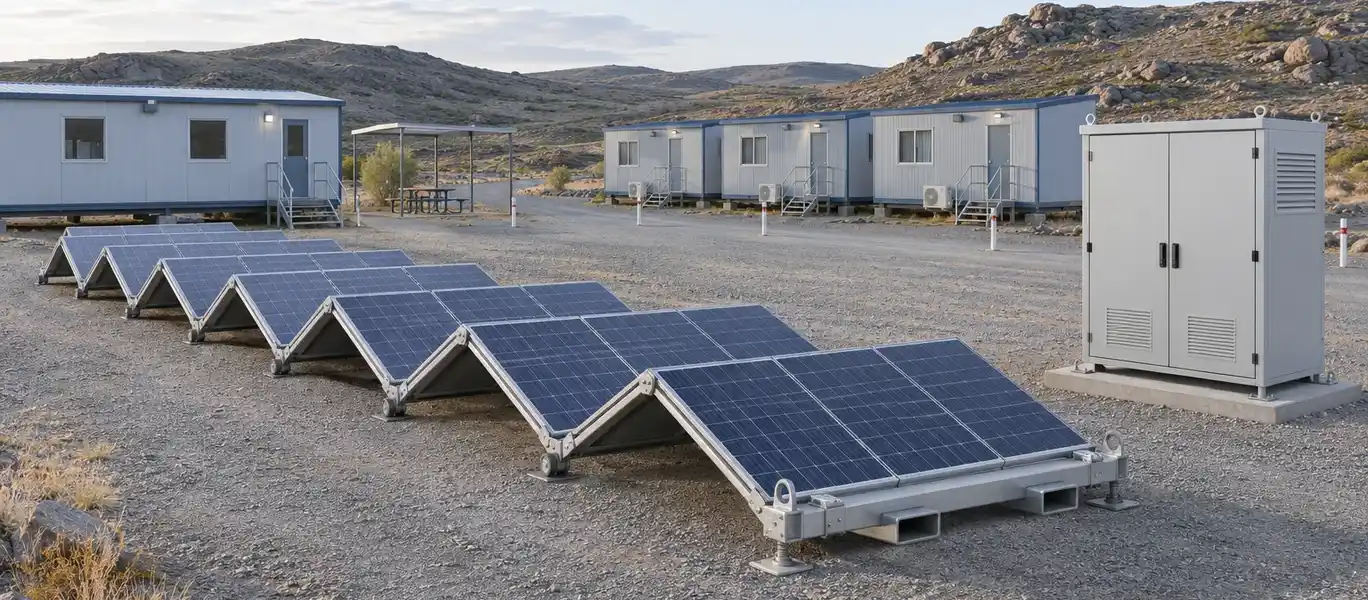
Illustrative remote camp scene. Define the supported loads, complete power package and site requirements before selecting equipment.
Site offices, accommodation, communications and selected auxiliary equipment can have very different power requirements from drilling, processing or major pumping operations. A useful proposal states which services are included and the conditions under which they will operate.
This guide helps project buyers and operators evaluate mobile solar power for industrial sites, exploration camps, remote monitoring stations and temporary support compounds. Use it to prepare the operating scope before comparing equipment packages or discussing integration with an existing power system.
Separate Camp Services from Production Loads
Start with a device and circuit list rather than a request to “power the site.” Record quantities, operating hours, measured demand where available, starting requirements and allowable interruptions. Identify the person responsible for approving new loads as the project grows.
For solar power for mining camps, sleeping quarters, offices and a core shed may share a location while following different schedules. Kitchens and accommodation heating or cooling can dominate particular periods. A small communications load may run continuously, while a workshop tool operates briefly at much higher power.
Load group | Typical examples | What the supplier needs |
|---|---|---|
Continuous camp services | Communications, routers, approved monitoring equipment and selected refrigeration | Day-and-night demand, interruption limits, duty cycles and environmental conditions |
Occupancy and shift loads | Office equipment, accommodation services, lighting, cooking, heating or cooling | Occupancy, shift changes, coincident demand and seasonal operating hours |
Loads that can be scheduled | Selected water transfer, equipment charging and noncritical utility tasks | Permitted operating windows and how much demand can move into solar hours |
Intermittent industrial loads | Workshop tools, welders, pumps and selected drilling-support equipment | Starting or peak demand, duration, power quality and simultaneous operation |
Production and safety-critical systems | Processing equipment, major plant, safety controls or essential ventilation | A separate approved engineering and continuity scope; inclusion cannot be assumed |
Keep daily energy in kWh separate from continuous and starting power in kW or kVA. Record single-phase or three-phase requirements and relevant equipment limits. Off-grid industrial solar power must be matched to the actual service, including how loads overlap.
The Saskatchewan Research Council's remote remediation camp case illustrates why this matters. Equipment sized for an earlier demolition phase no longer matched the camp's later demand. SRC monitored the load before designing a hybrid arrangement. Recheck the brief whenever the project phase changes.
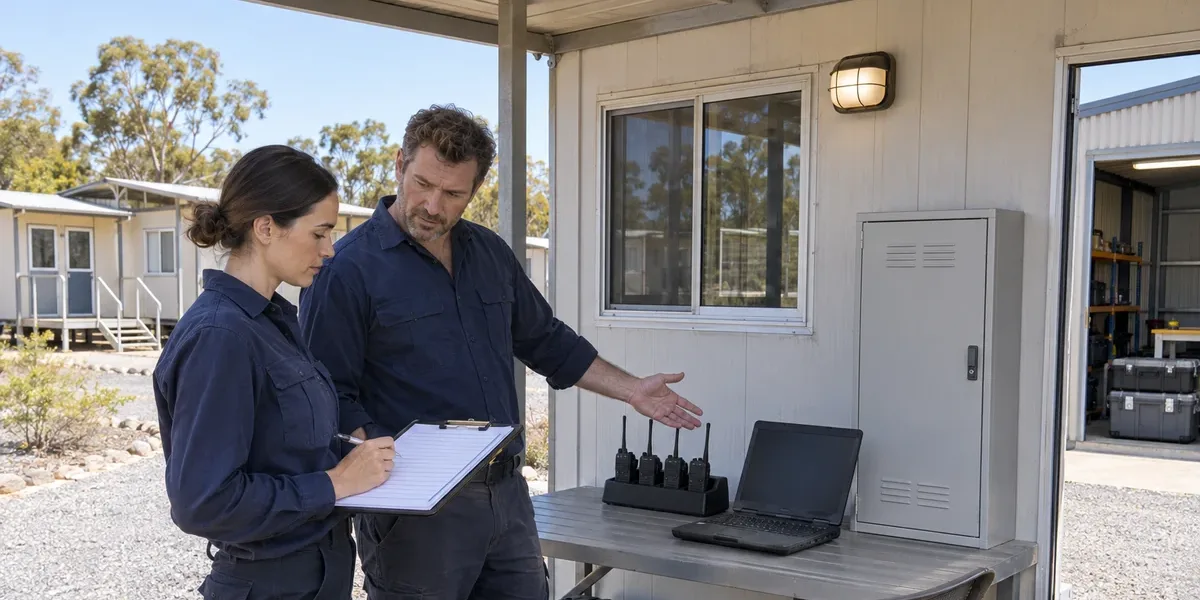
Illustrative load review. Confirm actual devices, operating hours and approved circuit boundaries with the site team.
Confirm the Complete Power-System Scope
A deployable solar array supplies PV electricity. The wider installation needs compatible equipment to manage charging, deliver the required output and coordinate other sources. Compare remote camp power systems by their itemized scope, not by the name on the enclosure.
Element | Confirm in the proposal |
|---|---|
PV array | Rated DC capacity, deployed footprint, operating voltage and current, connectors and compatible input limits |
Battery storage | Usable energy under stated conditions, charge and discharge limits, reserve settings, temperature management and auxiliary consumption |
Conversion and control | AC voltage, frequency, phase, continuous and starting capability, source coordination and supported operating modes |
Generator interface | Existing machine details, approved charging or coupling arrangement, control compatibility and integration responsibilities |
Distribution and field equipment | Outlets, protection, cables, approved earthing and isolation arrangements, handling accessories, drawings and operator instructions |
For a Mobile Fold-Out Solar Array System, confirm whether the quotation includes the PV array, folding mechanism, handling base and wiring components only, or also includes storage, conversion and distribution. Mark items as included, optional or supplied by another party.
Some remote monitoring platforms provide DC or network-device outputs; a camp building may require a different AC supply. Similarly, a skid-mounted unit and a complete containerized microgrid can have very different supply boundaries. Read the interface and output schedule before allocating loads.
Check the Operating Season and Overnight Reserve
Solar power for field camps depends on location, months of operation, shading, weather and the installed system's operating limits. Obtain a seasonal energy estimate for the proposed site. An annual average can hide the month when accommodation demand rises while solar production falls.
Define the overnight service window explicitly. For illustration, a selected load group averaging 3 kW for 10 hours uses 30 kWh at the loads. The battery arrangement needs additional allowances for conversion losses, permitted reserve, temperature effects and its own operating consumption. This is an illustrative energy calculation, not a recommended battery capacity or a Hinergy specification.
Confirm what happens the following day. Solar generation may need to serve the live camp demand while replacing energy withdrawn overnight. Charging limits, equipment temperature, changing sunlight and the available charging window can constrain recovery.
The Incident Energy Systems Model guide describes solar, battery and generator scenarios for portable camp facilities. Its value here is the method of examining a daily operating profile. Build the industrial site's own profile rather than importing a fire-camp scenario.
Use our load, PV and battery sizing guide for the calculation steps. Its example concerns a construction compound; recalculate with the camp's occupancy, shifts, climate and required reserve.
Integrate Solar, Batteries and Existing Diesel
A solar battery diesel hybrid system can retain an existing generator while changing when it runs. The proposed operating plan should explain the role of each source and the conditions that require backup.
During useful solar hours, PV may supply demand and charge storage, subject to controller limits and the approved design. During a planned engine-off period, the battery and inverter serve the agreed load group within their power and energy limits. When low solar input or additional demand threatens the required service, an approved backup source must remain available.
Ask for integration checks before accepting automatic operation. Provide the generator model, electrical rating, voltage, phase, control interface, fuel data and manufacturer operating requirements. The qualified design team should confirm starting demand, power sharing, charging allocation, source transfer, protection and the way the system establishes voltage and frequency when operating independently.
An energy management system does not make every generator or inverter interchangeable. Confirm which functions are actually included, whether expansion is supported and who is responsible for commissioning changes. If equipment will operate in a classified or otherwise restricted industrial area, include the site's applicable requirements in the brief.
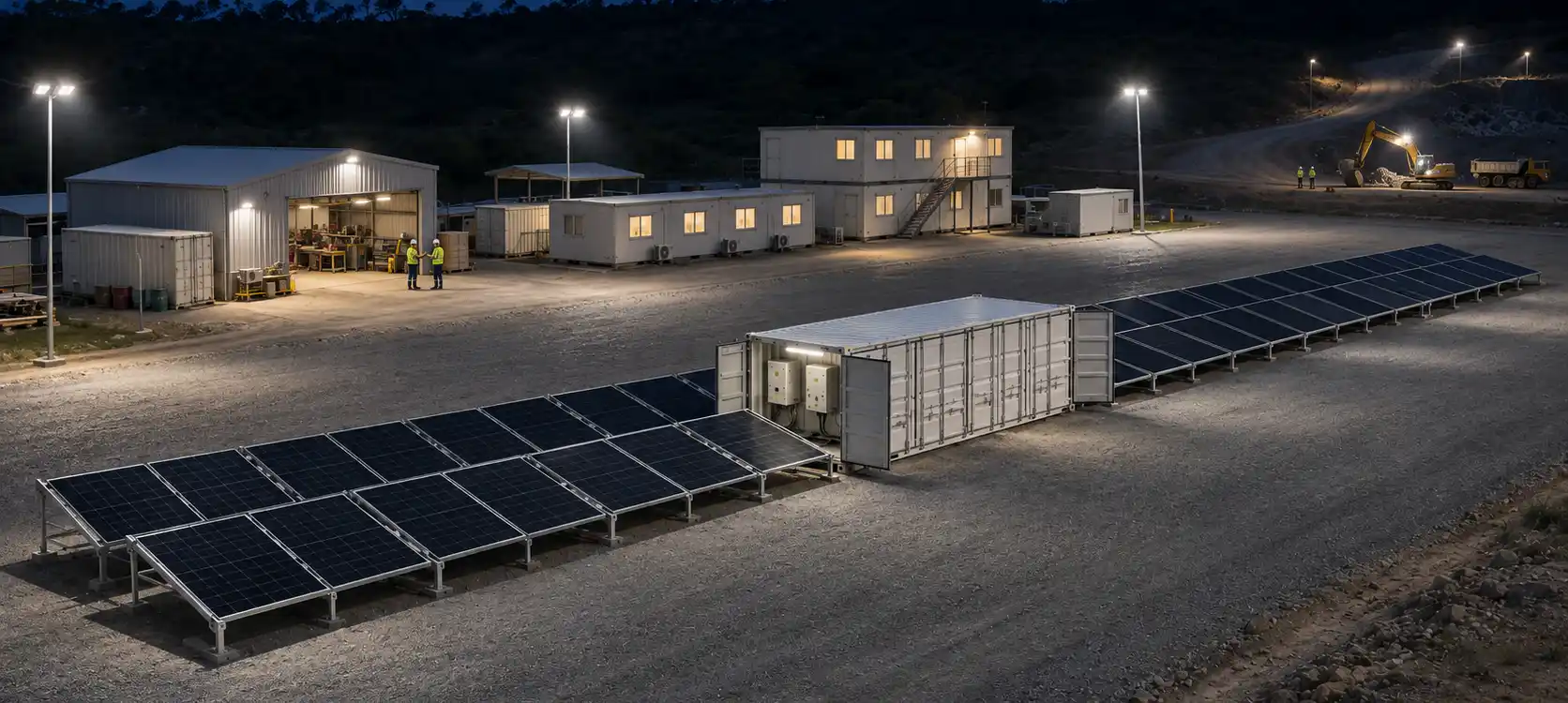
Illustrative equipment arrangement. Actual separation, connections and operating limits require the approved site design.
Set the reserve and backup rules with the responsible operators. Define how a low-energy forecast, an alarm, loss of communications or a sudden load increase is handled. Check whether scheduled tasks can move into solar hours without affecting the site's required service.
Agree acceptance checks under the approved procedures, including source transitions and the supported loads. Keep the appropriate alternative supply and local response arrangements for services whose interruption cannot be accepted. A lower expected generator runtime is not, by itself, evidence that continuity requirements have been met.
Match the Platform to Site Duration and Relocation
Mobility is an operating requirement as well as a transport feature. State how long the system will remain at each location, how often it will move and which equipment and people will be available at both ends.
Deployment pattern | Selection priorities |
|---|---|
Short stays with frequent moves | Packing, transport restraints, handling equipment, repeated setup labor, commissioning checks and recovery access |
Seasonal camps with planned relocation | Operating-season yield, storage between seasons, removable infrastructure, local spares and the next receiving site's requirements |
Longer stays or phased expansion | Lifecycle service, replacement parts, future load growth, recoverable equipment and total mobilization cost |
PHNXX's remote mining accommodation camp case describes relocation on a project timescale. That is a useful reminder to include the move schedule in procurement. Its deployment claims and reported savings belong to that specific supplier's case.
A pallet-based fold-out array needs a suitable carrier, approved unloading arrangements and the full deployed ground area. A trailer needs compatible towing and route access. Containerized equipment needs delivery, set-down and recovery resources. Our comparison of fold-out arrays, solar trailers and solar containers explains the formats.
For relocatable solar power systems, use model-specific drawings to check mass, handling points, ground conditions, restraint and environmental limits. Keep arrays, enclosures and cables clear of access and evacuation routes. See our mobile solar array deployment and stowage guide for the detailed receiving and handling checklist.
Plan Remote Monitoring and Local Maintenance
Remote visibility helps operators identify changes in solar input, energy use and equipment condition. It works best when each alarm leads to an assigned action and a person who can carry it out.
Agree the useful data: PV energy, load energy and peaks, battery state and temperature, alarms, generator hours and fuel records where supported. Define access rights, reporting intervals, data ownership and how records can be retrieved for review.
The 123eSolar remote seismic monitoring case distinguishes measured solar generation, load energy and generator contribution over a stated period. That reporting structure is useful for assessing performance. Results from one location and season do not establish year-round camp capability.
Check what remains functional if the communications link is unavailable. Document the approved local operating mode, alarm indication, record retention and escalation process. Agree who can inspect the equipment, how long support may take to arrive and what happens while a fault is unresolved.
Create a maintenance and spares plan around access constraints. Consider permitted cleaning methods, dust, vegetation, enclosure ventilation, temperature management and inspection after transport. Confirm which replacement components the local team can service and which require qualified specialists. Remote monitoring complements those arrangements; it does not provide physical repairs.
Compare Delivered Cost and Prepare a Site RFQ
Compare proposals against the same service level and project duration. Include equipment or rental charges, transport, repeat deployment, integration, site preparation, fuel delivery, maintenance, communications, staffing, spares and recovery. State how taxes, ownership and residual value are treated where they affect the quotation.
Ask how fuel or operating savings were established. A forecast should state its load profile, solar resource, operating strategy, baseline and assumptions. Measured results need a location, period and record of the service delivered. Cinergy's mining application page explicitly identifies its design-study figures as modeled outcomes, which is a useful distinction when comparing claims.
Before requesting equipment, put the following information into one remote site power planning brief:
RFQ field | Information to provide |
|---|---|
Site and operating period | Location, access route, operating months, project phases and expected occupancy |
Load boundary | Device or circuit schedule, excluded production loads, daily energy, peak and starting demand, required output and interruption limits |
Existing power | Generator and inverter details, control interfaces, present operating pattern and available fuel records |
Reserve and backup | Required overnight service, seasonal assumptions, recovery window, reserve policy and alternative supply |
Deployment and relocation | Stay duration, expected moves, footprint, carrier, handling equipment and return arrangements |
Operating environment | Temperature, dust, rain, flood exposure, wind conditions and any restricted-area requirements |
Support and acceptance | Local operator, connectivity, response responsibilities, spares, approved checks and handover records |
Commercial comparison | Itemized supply scope, mobilization, integration, service inclusions, warranty terms and the basis of performance estimates |
Review the brief when occupancy, shifts or industrial activity changes. An equipment package that suits one project phase may need a different allocation, additional capacity or another approved supply arrangement later.
Frequently Asked Questions
Can mobile solar power an entire mine?
A complete mine requires an engineered power system matched to production demand and continuity needs. A mobile array may contribute to selected camp services or auxiliary loads. Confirm that boundary before extending any claim to the whole operation.
Can an existing diesel generator remain in service?
How much storage does a quiet overnight period need?
How often can a fold-out array be relocated?
What should a remote camp solar RFQ include?