



Solar street light specifications should connect a lighting requirement to a complete, verifiable system. Before comparing quotations, confirm the site, lighting targets, operating schedule, seasonal solar input, usable battery energy and installation scope. Then request documents for the exact proposed configuration. A useful specification sheet identifies what each value measures, under which conditions it applies and how it will be checked. This guide helps project buyers turn catalog claims into comparable requirements, from the first inquiry to delivery.
Start with One Project Brief for Every Supplier
For commercial solar street lights, give each bidder the same location, road dimensions, shading information, mounting constraints and nightly service requirement. Agree the applicable lighting criteria with the project designer or authority, including maintained light levels, uniformity and glare where required. There is no single wattage, pole spacing or battery reserve suitable for every road.
Keep system architecture separate from performance. An integrated assembly and a separate-panel system can be evaluated against the same brief. If component positioning remains undecided, first compare all-in-one and split solar street light designs.
Solar Street Light Specification Checklist
Use this table when reviewing a solar street light datasheet. Record the offered value, document reference and any deviation beside each item in your procurement worksheet.
Specification | What to confirm | Documents to request | Common ambiguity |
|---|---|---|---|
Lighting duty | Road geometry, maintained targets, hours/night | Site brief and lighting calculation | Brightness without a defined task |
Luminaire input, W | Electrical input at each operating stage; measurement boundary | Electrical test data and control schedule | Marketing watts or LED-chip rating |
Light output, lm; efficacy, lm/W | Whole-luminaire output and matched input | Photometric report for offered configuration | Chip lumens presented as fixture output |
Optics, CCT and CRI | Distribution, color requirements and mounting geometry | Matching IES/LDT file and layout | Similar-looking optic substituted |
PV module, Wp | Rating conditions, orientation, tilt and shading | Module datasheet and site-yield calculation | Rated power treated as daily energy |
Battery, V / Ah / Wh | Pack voltage, nominal capacity and usable-energy basis | Pack datasheet, BMS limits and calculation | Ah without pack voltage |
Autonomy and recovery | Starting charge, load, solar input and recovery criterion | Seasonal energy model | Backup nights without assumptions |
Controller | PV/battery compatibility, charging limits and firmware settings | Controller data and wiring/program schedule | “Smart” without a defined program |
Temperature, °C | Separate charge/discharge limits and protective behavior | Battery and system operating limits | Discharge range used for charging |
IP, IK and corrosion | Protected enclosure, test scope and finish requirements | Applicable reports and coating specification | IP treated as corrosion evidence |
Pole and mounting | Complete loads, interfaces, anchors and foundation responsibility | Drawings and site-specific structural review | Pole height treated as structural approval |
Service and supply scope | Access, spares, freight, installation and warranty responsibilities | Manuals, itemized quote and written terms | Light-only price compared with turnkey scope |
Check Lighting Performance Beyond the Wattage Label
Separate electrical consumption from road performance
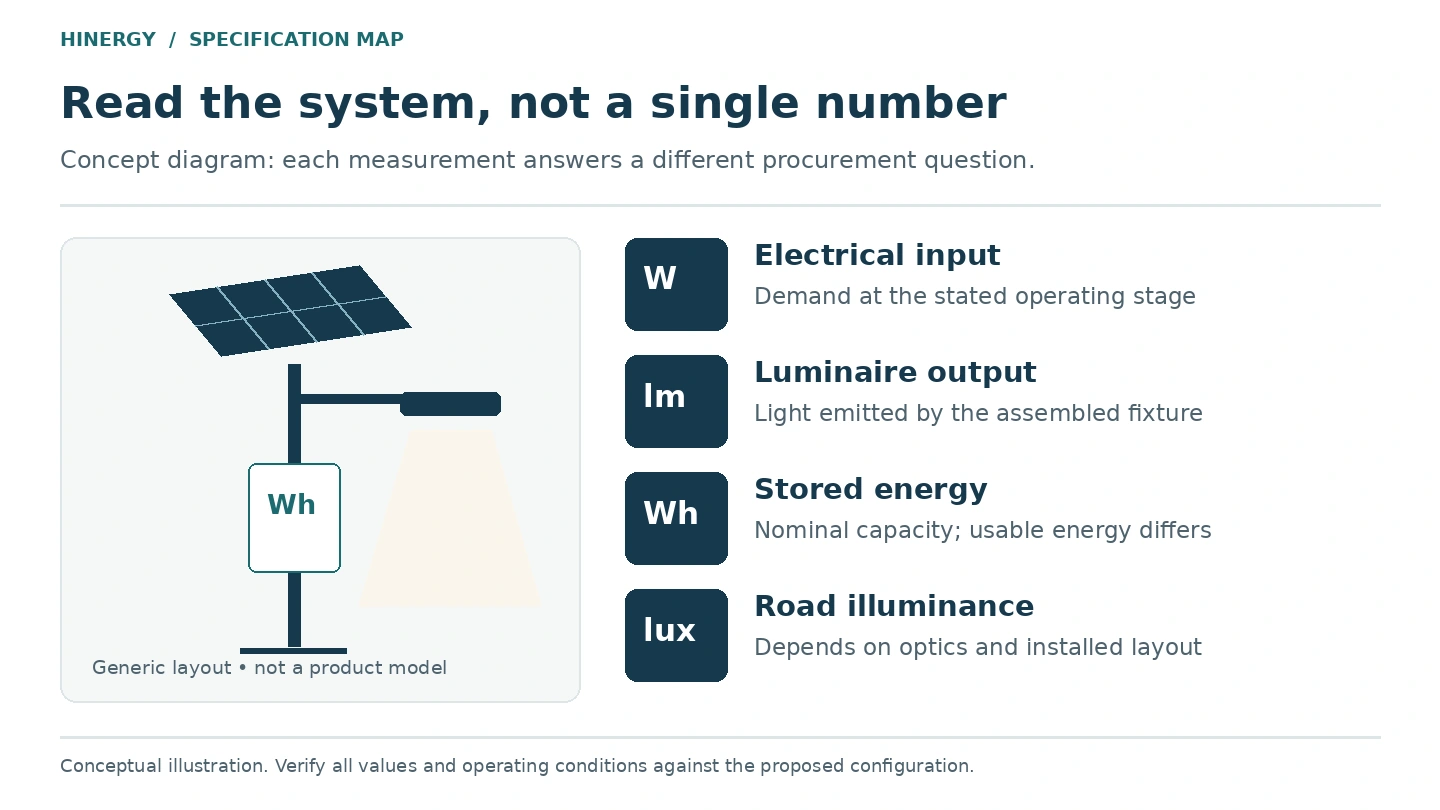
Watts measure power; lumens measure luminous flux; lux measures illuminance on a surface. Roadway requirements may also use luminance in cd/m². A higher input wattage does not establish better road coverage. Compare the offered luminaire's measured output, optical distribution and installed layout together.
For solar LED street light specifications, request photometric results identifying the model, optic, output setting and test conditions. The IES standards collection includes methods for optical/electrical measurement and photometric data exchange. A component lumen-maintenance report is not a complete street-light performance guarantee. See IES measurement and lighting standards.
Make the simulation match the quotation
Solar street light photometric files should match the proposed configuration. Check the layout's mounting height, spacing, tilt, road width and maintenance assumptions. Include approved reduced-output stages where their lighting performance matters. An IES or LDT file is an input to a calculation, not proof that a different installation will comply.
Compare Battery Capacity in Wh, Then Check Usable Energy
Solar street light battery capacity in Ah is incomplete without nominal pack voltage. Nominal energy, Wh ≈ nominal voltage, V × capacity, Ah. Compare capacities at stated temperature and discharge conditions; then examine the permitted discharge window, protection cutoffs and design allowances.
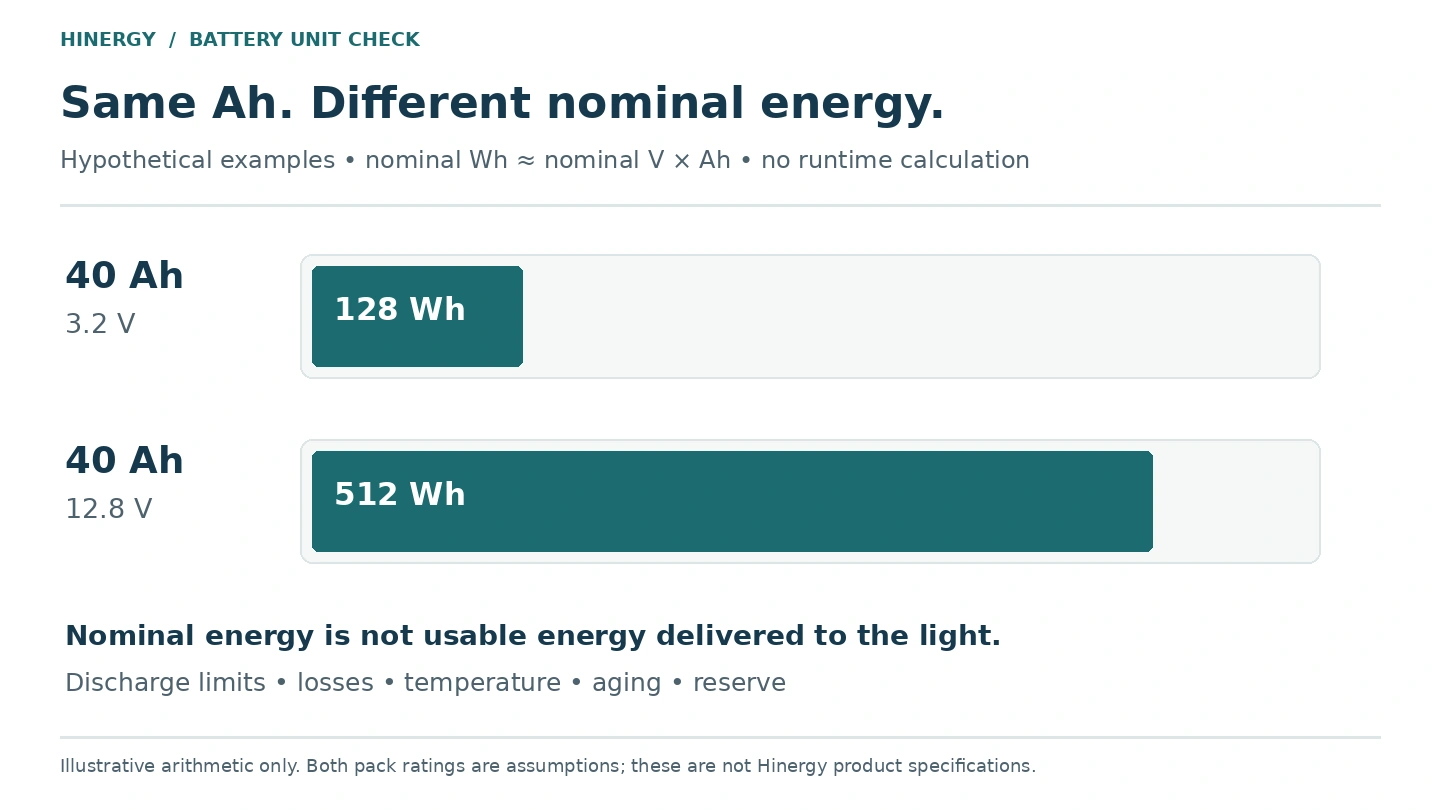
The JRC PVGIS manual distinguishes nominal battery capacity from the discharge cutoff. Request the selected pack's usable-energy calculation and state whether its endpoint is battery output or luminaire input, so losses are neither omitted nor counted twice.
Verify Solar Charging, Backup Nights and Recovery Together
The solar panel wattage specified for a street light describes power under specified test conditions, not daily energy delivered to storage. Request a site-based assessment using the installed orientation, tilt, shading and seasonal weather. Review the limiting operating season rather than relying only on annual totals.
For solar street light technical specifications, an autonomy claim needs a defined initial charge, allowed light-output schedule, temperature basis and assumption about solar contribution. “Three backup nights” can describe very different service levels.
Ask what happens after that reserve is used. The panel must support continuing operation while restoring charge under the stated recovery conditions. PVGIS off-grid calculations track generation, consumption and battery state; review modeled shortfalls as well as energy totals. Use the street light's actual hourly load profile.
Specify the Controller Program and Every Additional Load
Request timed electrical-load settings, sensor behavior, low-battery response and commissioning settings. A “50% brightness” command does not establish 50% electrical consumption. Confirm the delivered light level at each required stage and whether automatic energy-saving behavior is acceptable.
For MPPT or PWM charging, verify compatibility with module voltage, charging current and battery requirements. A controller label alone does not establish a fixed energy gain. Include CCTV, communications and other loads over their complete daily operating periods, not just lighting hours.
Review Temperature, Enclosures and the Complete Mounting Assembly
Charging and discharging can have different temperature limits. Check the actual battery data, enclosure conditions and any heating or charging inhibition. The Victron technical data illustrates why these limits must be read separately; its model ratings are not Hinergy specifications.
IEC 60529 covers enclosure IP classification, while IEC 62262 covers external mechanical impact classification. Neither label alone establishes coastal corrosion suitability. Specify applicable protection and finish requirements for each relevant enclosure and connection.
Review solar street light pole height and spacing through both lighting and structural checks. Include the luminaire, panel, brackets, battery enclosure and accessories in the load assessment. Identify who verifies the existing pole or new foundation. For maintenance, confirm isolation, lifting access, replacement compatibility and resealing procedures.
Turn the Datasheet into a Comparable Purchase Package
Before requesting final prices, explore Hinergy solar street light models against the agreed brief. Ask each solar street light manufacturer or supplier to identify the offered model, component configuration, drawings, control program and document revisions.
For solar street light tender specifications, distinguish proposed requirements from verified compliance. Agree which tests, inspections and commissioning records demonstrate acceptance, with methods and tolerances set before purchase. Confirm that submitted reports cover the offered model and configuration. An unrelated certificate cannot close a technical deviation.
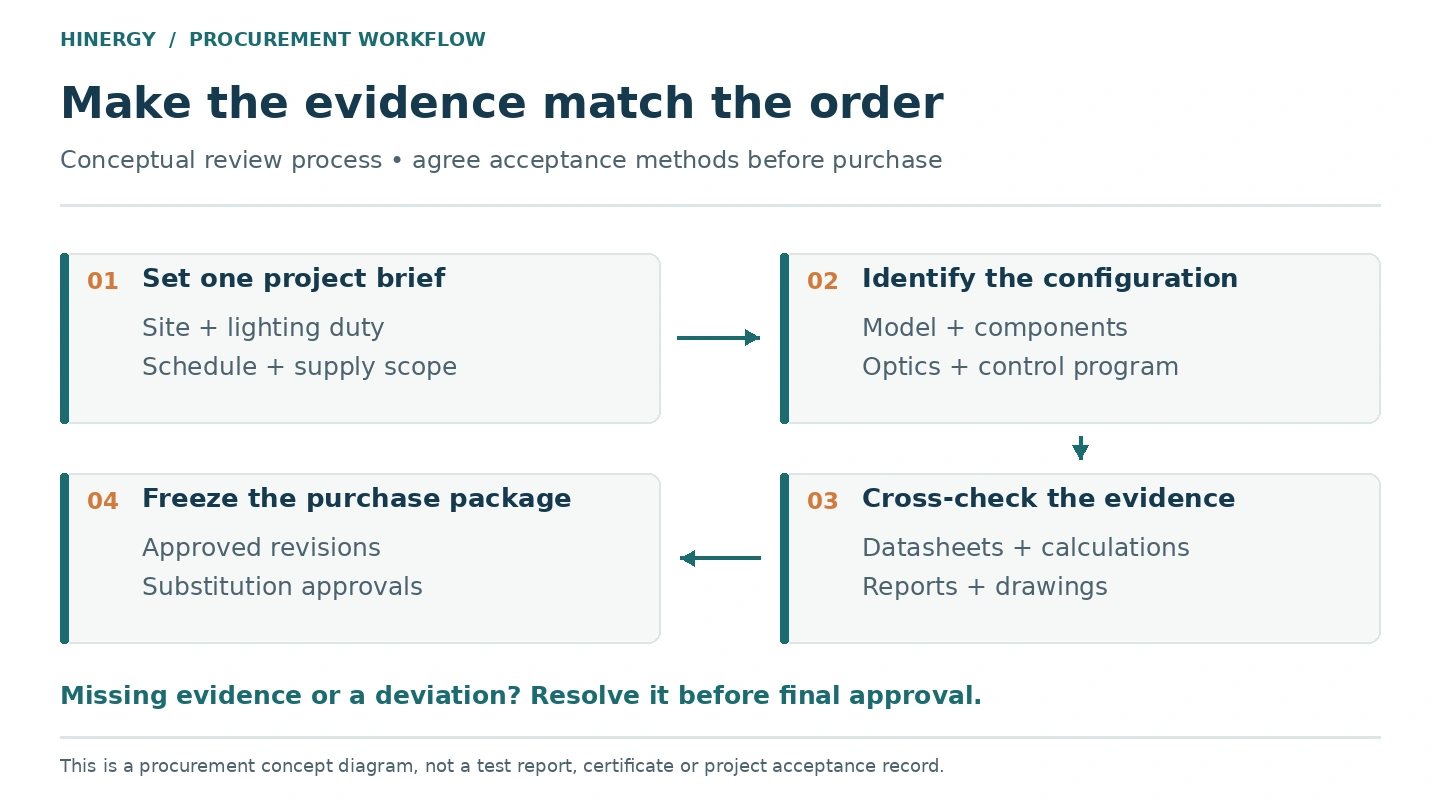
Prepare these items for your inquiry:
Location, site drawings, road width and shading photographs.
Pole arrangement, existing structures and access constraints.
Lighting targets, nightly schedule and permitted dimming.
Reserve requirement, climate conditions and additional loads.
Quantity, delivery destination, supply scope and required documents.
Frequently Asked Questions
What should a solar street light specification sheet contain?The exact configuration, lighting data, panel and battery ratings, operating program, environmental limits, mounting details and supporting document references. Include assumptions behind runtime claims.Can I compare two batteries using Ah alone?Only with the same voltage and compatible rating conditions. Convert to nominal Wh first, then compare usable energy at the same system boundary and operating conditions.Is there a standard pole spacing for solar street lights?No universal spacing fits every project. Validate the proposed optics, mounting geometry and road criteria in a lighting calculation; review structural suitability separately.Does a larger panel guarantee all-night operation?No. Exposure, seasonal generation, storage, charging limits and the approved load determine performance together. Verify reserve and recovery for the actual site.Which documents should I request before ordering?Request model-specific datasheets, matching photometry and layout, energy assumptions, drawings, applicable test evidence, service instructions and written commercial terms. Resolve missing evidence before final approval.
Technical References
IES Lighting Library — measurement methods and lighting guidance.
JRC PVGIS user manual and off-grid system guidance — rating inputs and energy modeling.
IEC 60529 and IEC 62262 — IP and IK classification scopes; applicable editions must be confirmed for the project.
Victron battery technical data — an external example of separate capacity and operating-limit declarations.