



What Changes Between All-in-One and Split Designs?
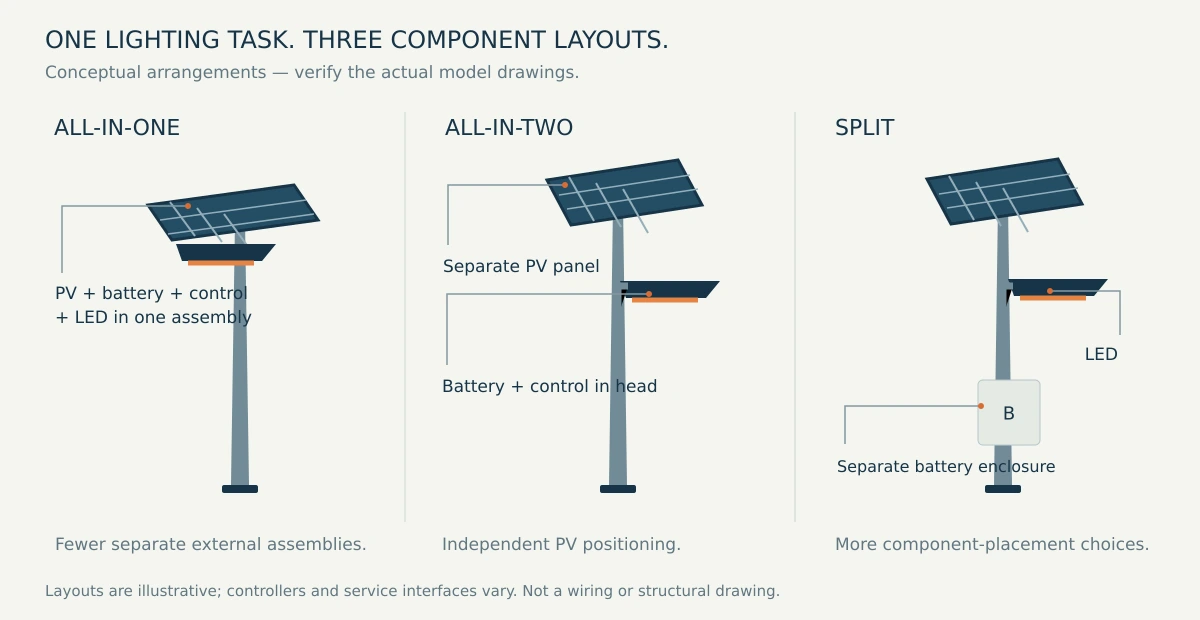
An integrated solar street light packages charging, storage, control and illumination into one coordinated unit. Check the assembly drawing: battery access, panel adjustment and replaceable modules differ between models. “Integrated” describes packaging; it does not establish a universal wattage ceiling, battery chemistry or operating life.
A split solar street light locates the panel, luminaire and battery arrangement separately. The controller may share an enclosure with another component. This layout can accommodate a different panel position or storage enclosure, while adding brackets, protected cable routes and installation tasks. Ground-level or buried batteries are options, not defining requirements.
Where Does an All-in-Two Solar Street Light Fit?
An all-in-two solar street light commonly places the battery and controller with the LED head and mounts the photovoltaic panel separately. This semi-integrated arrangement is worth reviewing when independent panel positioning matters but a separate battery enclosure is unnecessary. Supplier terminology varies: request a component-location drawing before comparing quotations.
Vertical solar panels describe panel geometry; single-arm and double-arm poles describe mounting. These dimensions can overlap with different integration layouts. For the broader product overview, see solar street light designs and project selection.
All-in-One vs Split Solar Street Lights: Comparison Table
Use this all-in-one vs split solar street lights comparison as a shortlist tool. Neither column is a performance certificate: verify every claim against the proposed configuration and project conditions.
Compare the actual configurations, not the names alone.
Comparison factor | All-in-One Solar Streetlight | Split Solar Streetlight |
|---|---|---|
Component integration | Combined assembly; verify internal modules. | Separately located components; verify controller position. |
PV positioning | Adjustment depends on the housing and bracket. | Separate mounting can permit independent positioning. |
PV and storage capacity | Must fit the approved assembly and loading limits. | More sizing freedom within the approved system design. |
Field installation | Fewer external assemblies and interconnections. | More fixing, cable routing and connection work may be needed. |
Service access | Inspect battery/controller access, isolation and lifting needs. | Inspect each battery/controller enclosure and access method. |
Pole, wind load and space | Check weight, wind-exposed area, mounting moments and clearances. | Check all component loads, wind exposure and installation space. |
Cost boundary | Include packaging, transport, installation, access and replacements. | Include the same scope plus separate hardware and wiring. |
Evidence required | Exact datasheet, drawings, photometry and energy assumptions. | The same evidence, plus complete component and wiring schedules. |
Compare Both Designs Against the Same Lighting Requirement
Set the lighting task before comparing watts
For commercial solar street lights, give both suppliers the same road width, pole layout, mounting height and maintained lighting targets. Watts measure power, lumens describe emitted light, and lux measures illuminance on a surface. Road performance also depends on distribution, uniformity, glare and maintenance assumptions. Request a photometric layout for the project-adopted lighting requirements. Source I1
Compare daily energy, usable storage and recovery
Solar street light battery capacity should be compared in watt-hours. Nominal energy is approximately voltage × amp-hours; usable energy additionally depends on discharge limits, temperature, aging and system losses. Check charge and discharge temperature limits separately against the selected battery specification. Manufacturer data can specify different limits for these two operations. Source J1 Source V1
Daily solar energy yield changes with location, season, panel orientation and shading. Panel watt-peak is rated power under test conditions, not the watt-hours delivered to the battery each day. Specify a street-light load profile instead of accepting a generic household profile in an off-grid simulation. The JRC’s PVGIS guidance describes hourly generation, consumption and battery accounting; annual production alone does not establish nightly service. Source J1 Source J2
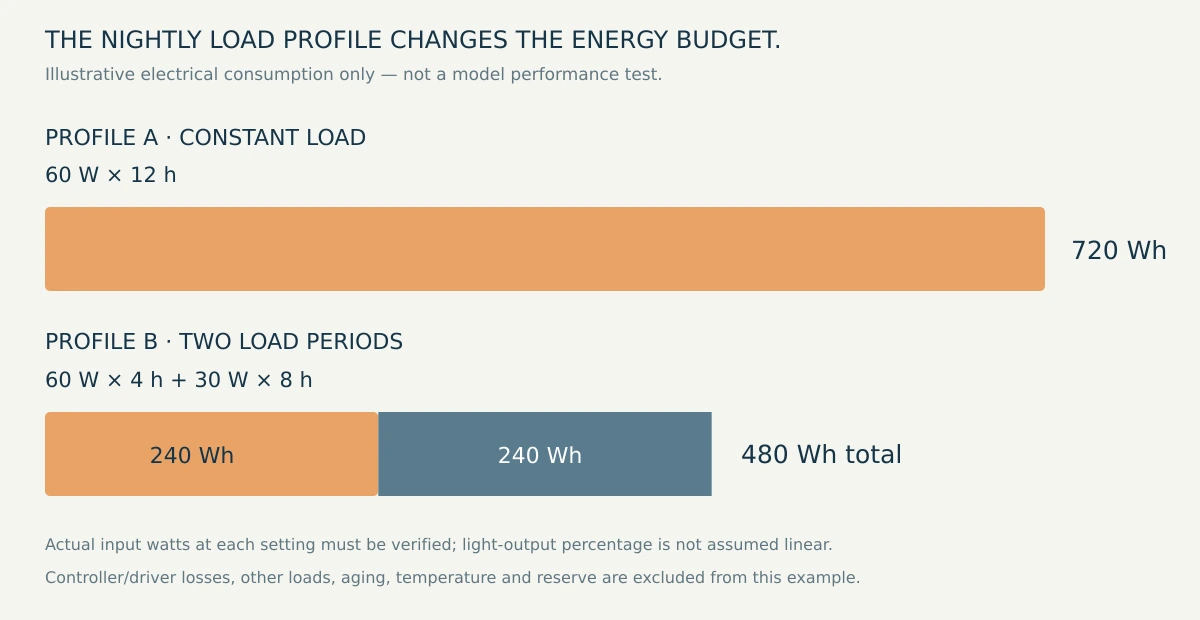
Battery autonomy and recharge recovery are separate checks. A reserve may carry the light through a low-solar period, yet recover slowly while subsequent nights continue consuming energy. Ask for seasonal battery-state results, the assumed starting charge and the recovery criterion. Acceptable dimming must remain consistent with the project’s lighting requirement. Source J2
When Is an All-in-One Design Worth Considering?
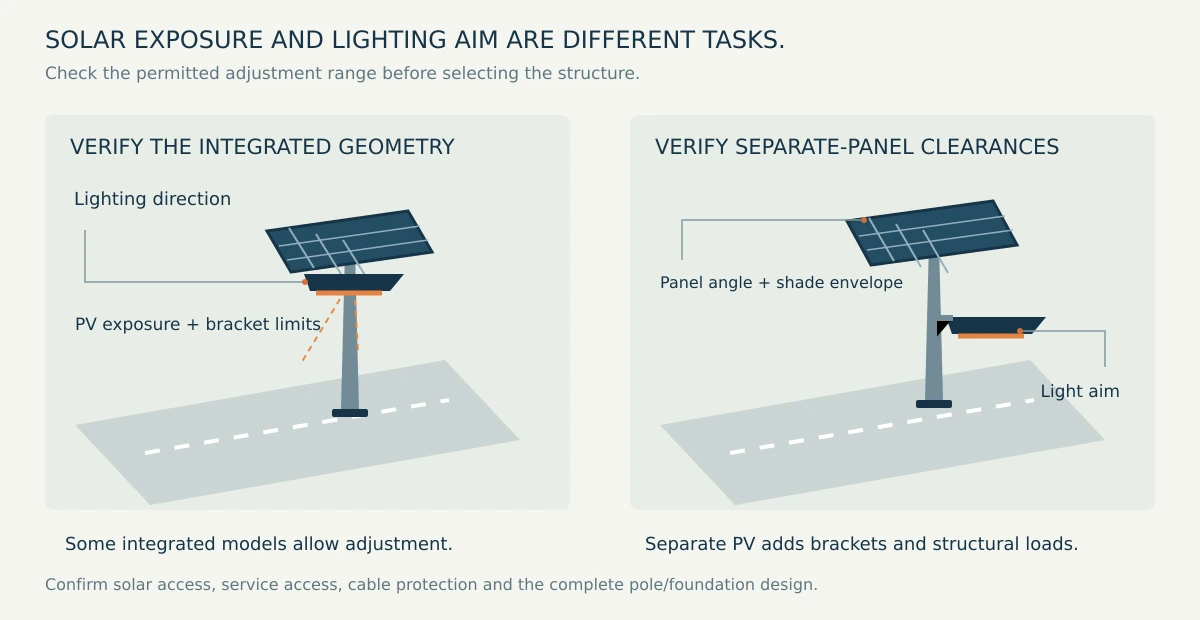
Consider an all-in-one solar street light for residential roads, rural routes or parking areas when the selected model satisfies the full brief. Fewer separate assemblies can simplify repeated deployments. That advantage is useful only if panel exposure, usable storage, approved adjustment ranges and service access also fit. A wide road is not automatically unsuitable; it needs an appropriate optical and energy design.
Panel and luminaire positions work together.
Storage supports the approved operating profile.
The pole and foundation suit the complete assembly.
Crews can safely inspect and replace approved modules.
When Is a Split Design Worth Considering?
A split solar street light is worth considering when independent component sizing or placement solves a demonstrated constraint: a different PV position, a separately accessible battery enclosure or energy capacity beyond a shortlisted integrated model. Examine cable protection, enclosure conditions and structural loads at the same time. A separate enclosure is not automatically cooler, theft-resistant or flood-safe; its location and design determine those characteristics.
For solar street lights in cloudy or winter conditions, splitting the components does not create sunlight. Verify seasonal generation, longer-night consumption, cold-charge limitations and recovery after low-solar periods. Sometimes relocation, an approved operating change or a revised energy configuration matters more than the architecture label.
Installation, Maintenance and Total Project Cost
Compare complete installation and service scope
Solar street light installation still involves an approved pole, foundation, lifting method and commissioning procedure. Integrated packaging can reduce field connections, but it does not remove structural or electrical checks. Split assemblies require coordinated mounting and protected connections. Request installation scope and crew assumptions rather than treating a generic minutes-per-pole claim as a project schedule.
For solar street light maintenance, compare the actual replacement task: isolate the system, reach the component, open the enclosure, disconnect it safely and restore sealing and settings. A split battery mounted high on a pole may still need lifting equipment. A serviceable integrated battery compartment may avoid replacing the complete luminaire. Confirm the approved procedure and spare-part specification.
Evaluate the same lifecycle boundary
Solar street light cost includes the supplied equipment, transport, civil works, mounting, wiring, commissioning, access equipment and future replacements. Compare quotations over the same study period and lighting duty, using documented service assumptions. Neither structure is always cheaper. Confirm price, MOQ, lead time and warranty scope against the exact model, customization and destination.
Project Information to Prepare Before Choosing
Location
Country, city or coordinates; seasonal shading.
Geometry
Road width, site plan, mounting height and spacing.
Lighting duty
Required light levels, uniformity, glare and nightly program.
Energy reserve
Low-solar duty, starting charge and recovery target.
Structure
Existing pole drawings, foundation and mounting constraints.
Environment
Temperature, wind exposure, corrosion and maintenance access.
Extra loads
CCTV, sensors, routers and their operating schedules.
Procurement
Quantity, destination, documents and requested delivery date.
Once the project brief is defined, explore Hinergy solar street light models to review available series and request configuration-specific documents. Keep model ratings separate from assumptions about what every integrated or split system can deliver.
Frequently Asked Questions
Turn Your Project Brief into a Comparable Quotation
Choose the layout that meets the lighting, energy, structural and service brief with a defensible cost boundary. Hinergy is a solar street light manufacturer in China; contact Hinergy team to review model selection, project requirements and OEM solar lighting enquiries. Confirm the proposed specification and available documentation before ordering.