



How Often Should Solar Street Lights Be Maintained?
Build the solar street light maintenance schedule from the product manual, commissioning records and site conditions. Dust, salt exposure, vegetation growth, extreme temperatures and construction nearby may justify closer attention. The handover pack should identify inspection responsibilities, service access and available diagnostics; our solar street light specification checklist helps define those documents.
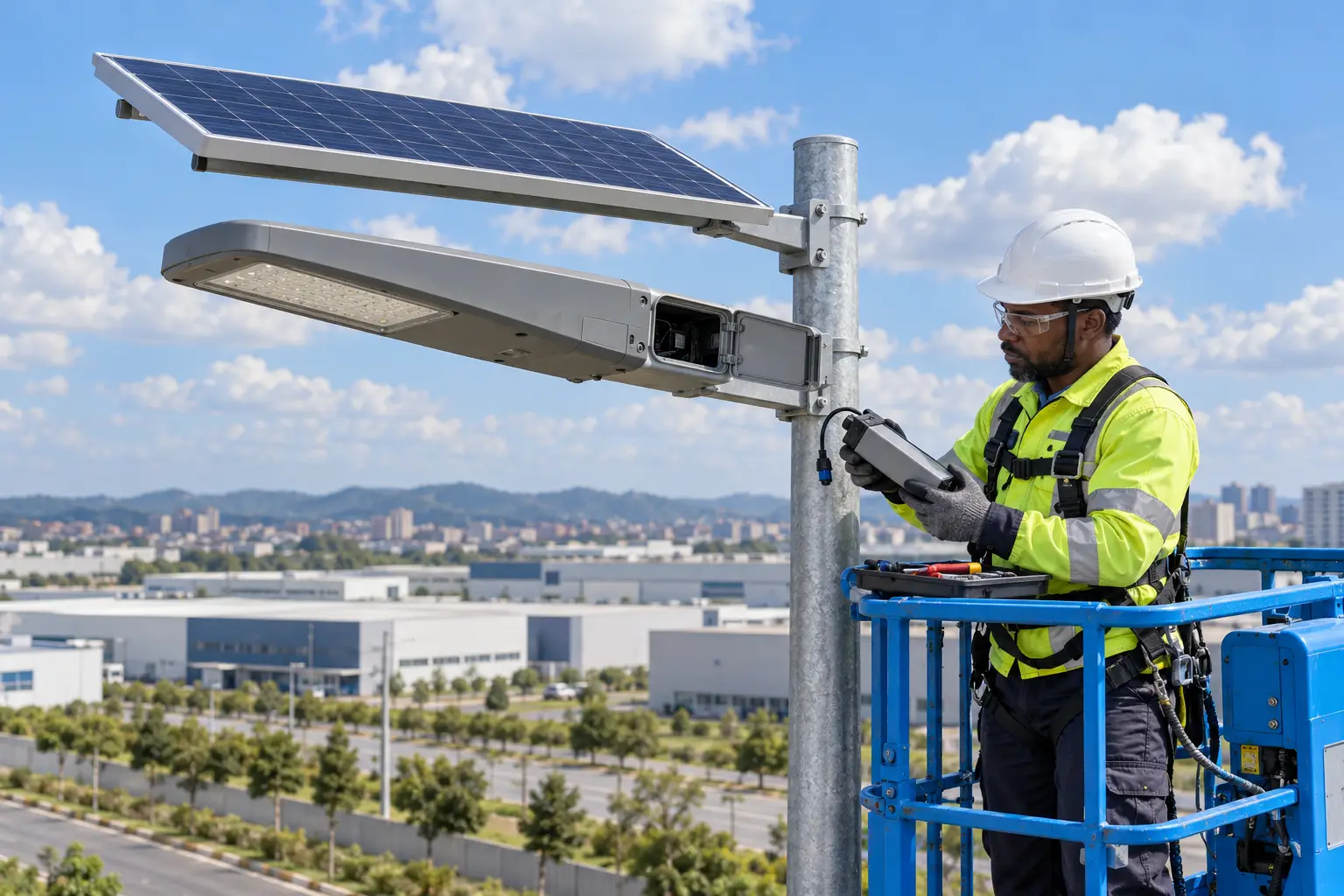
Routine Observation
Ground-level checks can identify dark units, changed operating hours, damaged poles and new shading. Compare the light with its approved dimming program: a scheduled reduction or sensor response can be normal operation. Use the same asset record for preventive maintenance and corrective work.
Detailed Inspection
Plan cleaning and specialist checks according to conditions and the manufacturer's instructions. An owner might start with monthly visual observations and a six-month detailed review, then adjust from findings. This is an illustrative maintenance plan, not a universal interval. Add inspections after storms, flooding, vandalism or nearby construction when safe access is available.
Solar Street Light Maintenance Checklist
Use this solar LED street light maintenance checklist for commercial installations, then adapt it to the supplied model. A routine visit does not require opening every sealed compartment. Record findings before changing settings or replacing parts.
Component | Inspection or Action | Trigger or Planning Basis | Record |
|---|---|---|---|
Solar panel (PV) | Check soiling, shading and mounting; clean using the approved method. | Visible buildup, shading changes or reduced charging; follow the panel instructions. | Photos and charging observations. |
LED luminaire | Check lens, housing and expected lighting behavior. | Uneven output, damage or unexpected dimming. | Pole ID, symptom and operating time. |
Battery and controller | Review available status, temperatures, settings and fault history. | Runtime changes, alarms or scheduled specialist service. | Model, readings, settings and codes. |
Cables and connectors | Inspect accessible routing, insulation, supports and connection condition. | Abrasion, corrosion, intermittent faults or site disturbance. | Location and repair findings. |
Enclosure seals | Check covers, gaskets and cable entries without compromising sealing. | Water marks, damaged covers or approved service work. | Defects, approved parts and closure checks. |
Pole and foundation | Check visible corrosion, movement, damage and mounting condition. | Routine structural inspections and significant weather events. | Photos and specialist follow-up. |
For solar panel cleaning, use the panel maker's permitted tools and cleaning agents. Avoid abrasive scraping, unapproved chemicals and pressure washing unless specifically allowed. Structural concerns and electrical measurements need appropriate specialist assessment.
Diagnose Short Runtime Before Replacing the Battery
A solar street light that turns off early may have a charging deficit, an increased load, a connection fault or an aged battery. For solar street light troubleshooting, compare the complaint with the original operating schedule and recent weather. Where monitoring is available, review several charge-and-discharge periods, not just the status at one visit.
Symptom | Possible Causes to Investigate | Useful Evidence |
|---|---|---|
Light switches off early | Shading, soiling, prolonged low solar input, changed settings or reduced battery capacity. | Shutdown times, weather, charging history and operating profile. |
Light is not working at night | Connections, protection state, controller, sensor, LED driver or battery fault. | Error codes, settings and approved electrical checks. |
Battery appears not to charge | PV or wiring fault, controller settings, temperature protection, or battery condition. | Solar exposure, temperature, controller status and test results. |
Light is dim or flickering | Programmed dimming, sensor activity, connection problems, driver issues or low available energy. | Timing, sensor response, connection findings and load behavior. |
Victron's controller troubleshooting documentation separates undercharging from other battery and charging faults, illustrating why system-level diagnosis matters. Its tests and thresholds apply to the specified controllers. 1
A single voltage reading cannot establish remaining battery capacity. Have the service team interpret measurements against chemistry, temperature, charging history and load, using the approved diagnostic procedure.
When Does a Solar Street Light Battery Need Replacing?
Plan replacement when evidence shows the battery can no longer support the required lighting duty after charging and system faults have been addressed, or when the manufacturer identifies a battery defect. A capacity test, where permitted, needs defined charge conditions, temperature, discharge rate and endpoint.
Battery age, cycle-life ratings and warranty duration describe different things. Neither a fixed age nor a universal remaining-capacity percentage proves that every pack needs replacement. Record the test result and the project's required service before deciding.
Swelling, leakage, unusual heat, burning odor or physical damage requires professional assessment. Stop service attempts on a damaged pack; do not open sealed batteries or bypass their protection.
Choose a Compatible Replacement Battery
Start with the approved replacement battery for the solar street light model and production revision. If that part is unavailable, obtain confirmation of an alternative. Matching Ah, housing size or connector appearance alone does not establish compatibility.
Item | What to Confirm Before Ordering |
|---|---|
Chemistry and voltage | Approved chemistry, nominal voltage, operating limits and controller charging profile. |
Capacity and usable energy | Voltage, Ah, Wh and usable energy suitable for the agreed nighttime duty. |
Battery management system (BMS) | Applicable current limits, temperature protection and communication or enable requirements. |
Charging compatibility | Panel and controller capability, battery charge limits and approved settings. |
Mechanical fit | Dimensions, mounting, weight, cable clearance and service access. |
Electrical interface | Connector pinout, polarity, cable and fuse requirements, and weatherproof connections. |
Temperature limits | Permitted charging, discharging and storage conditions for the location. |
Identification and support | Part number, revision, documentation, warranty and replacement availability. |
LiFePO4 is one lithium-ion chemistry; the broader label “lithium battery” is insufficient for ordering. For a changed duty or proposed capacity increase, check solar street light battery sizing and charging recovery. A larger pack cannot correct persistent shading or inadequate daily solar energy.
Plan Battery Replacement and Recommissioning
Before Service
Confirm the approved procedure, warranty responsibilities, replacement part and safe access equipment. Electrical servicing and work at height require qualified personnel. A remote OFF command does not establish isolation: the panel can generate in daylight and the battery can supply fault current. Follow the model's disconnect and restart sequence. Victron publishes a specific sequence for its listed controllers; it is not a universal streetlight procedure. 2
During Replacement
Record the original labels, wiring and settings. Follow the approved removal and fitting instructions, inspect for the original cause of damage, and restore specified mounting, cable routing, gaskets and fasteners. Use required torque values; do not modify the enclosure to force a pack to fit. Signify's SunStay instructions similarly direct users to product-specific service information and tightening requirements. 3
An integrated solar street light battery replacement may involve a service hatch, removable assembly or factory service. All-in-one, all-in-two and split systems need their own access plan. Our all-in-one versus split solar street light comparison explains the layouts.
After Reconnection
Verify charging, fault status, the approved dimming program and sensor response. Observe nighttime operation under recorded conditions. One successful switch-on does not demonstrate full-night duty or multi-night autonomy. If runtime remains short, reopen the diagnosis rather than repeatedly replacing batteries.
Arrange suitable battery recycling under local requirements. Confirm the receiving service's instructions for used or damaged packs. EPA's U.S. guidance distinguishes business responsibilities from household collection; do not place lithium-ion batteries in ordinary trash or municipal recycling.
Repair the System, Replace the Battery or Replace the Unit?
Compare the practical options before buying solar street light spare parts:
Correct the underlying fault: cleaning, approved settings changes or connection repairs may address the complaint without a new battery.
Replace the approved battery: consider this when diagnosis supports replacement and the remaining system is serviceable.
Replace another assembly or the complete unit: consider damaged housings, unavailable compatible parts, repeated failures and the cost of safe access.
Solar street light battery replacement cost includes more than the pack: diagnosis, access equipment, labor, seals, transport and disposal may also apply. Confirm warranty responsibilities and compare the same scope. Our solar street light cost and quotation guide explains cost boundaries; actual solar street light maintenance costs remain project-specific.
What to Record and Send for Replacement Support
A solar street light maintenance log connects each intervention to the correct asset. Keep the commissioning baseline so later changes remain traceable.
Record | Information to Keep |
|---|---|
Asset identity | Pole ID, location, light model and serial number. |
Visit and conditions | Date, technician, weather and reported operating problem. |
Diagnostic evidence | Photos, settings, fault codes and measurements with test conditions. |
Work and parts | Actions, approved setting changes, old/new part numbers and serial numbers. |
Verification and follow-up | Charging and night-operation observations, unresolved issues and next review. |
For replacement support, provide battery and controller label photographs, service history, connector details where safely accessible, installation location, quantity and required delivery date. Separate different models or revisions. Ask the solar street light supplier to confirm the compatible part, documents, supply scope and availability before ordering.
Frequently Asked Questions
How Often Should Solar Street Lights Be Cleaned?
Use the panel instructions, soiling conditions and charging observations to set the interval. Dusty, coastal or construction sites may need closer attention. Rainfall alone does not establish that the panel is clean, and cleaning should not replace checks for growing shade or electrical faults.
Can the Battery in an All-in-One Solar Street Light Be Replaced?
Can I Use a Higher Ah Battery in a Solar Street Light?
Can a Gel Battery Be Replaced with LiFePO4?
Why Is My Solar Street Light Not Working After Battery Replacement?