



Define What the Solar Street Light Price Covers
A request for a “100W solar street light price” or a “6-meter solar street light cost” leaves important questions unanswered. Does the price include the pole? Which battery and operating program are offered? Where will the goods be delivered? The answers can change both the quoted amount and the work still required.
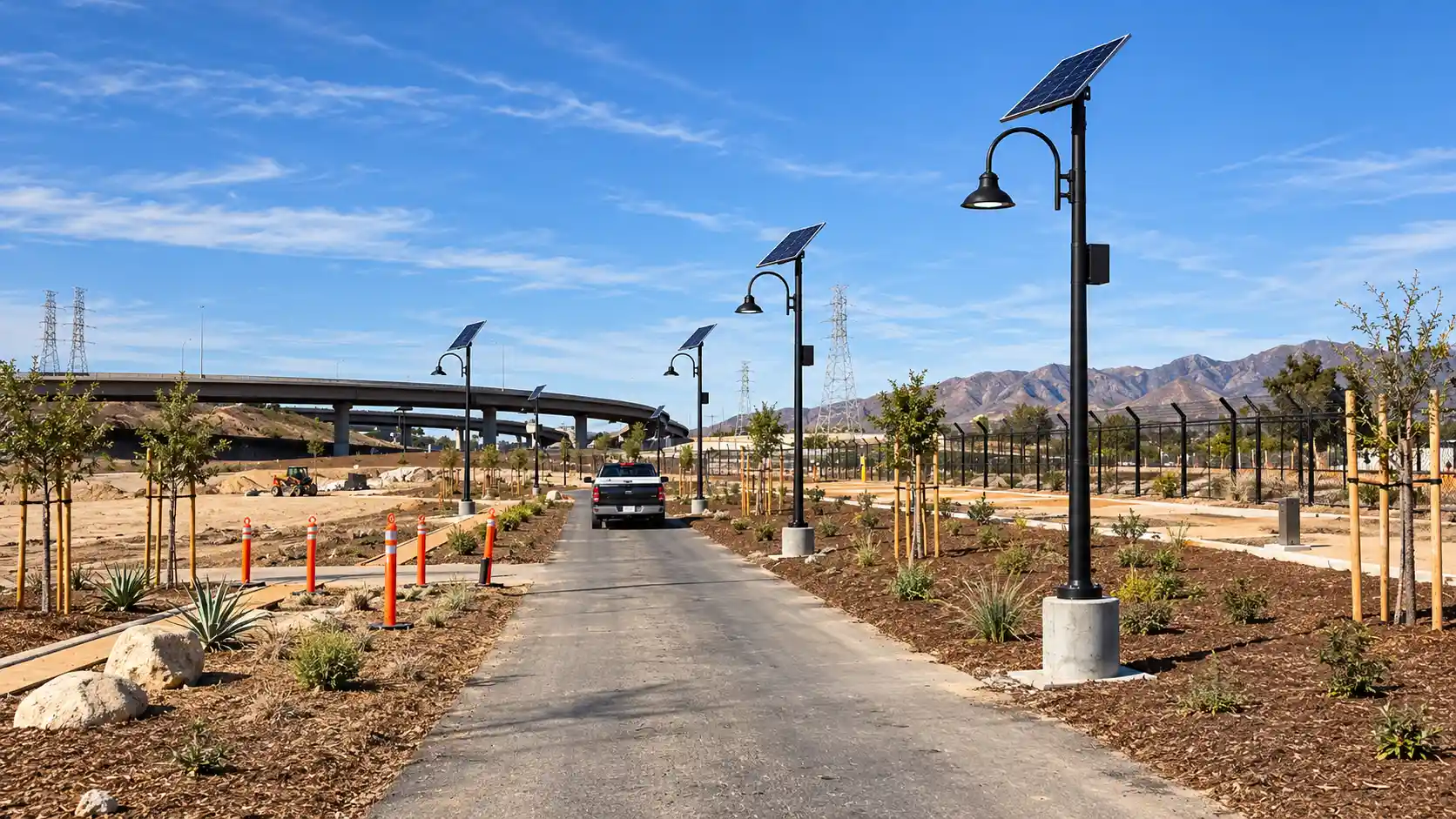
A useful solar street light cost breakdown separates three budget levels:
Equipment price: the defined lighting package, with poles and accessories included only where stated.
Delivered cost: equipment plus the agreed logistics and destination costs to a specified receiving point.
Installed project cost: delivered equipment plus the required local works, installation, testing and commissioning.
Define the currency, quantity and meaning of “one set” at each level. A low fixture-only price and a higher delivered-system price may describe different purchases. Neither number is useful for comparison until the scope is clear.
What Can Be Included in a Solar Street Light Quote?
Ask the solar street light supplier to mark each item Included, Excluded, Optional or To be confirmed. A blank line needs clarification; it does not establish that an item is free or supplied by someone else.
Lighting and Power Package
Identify the offered model, luminaire, solar panel, battery and controller, together with the approved operating program. In an integrated solar street light, these components may be priced as one assembly. Request configuration details without adding component prices again to a complete-package price.
Poles, Accessories and Project Services
Use the following solar street light quotation checklist to connect the equipment to the supporting structure, documents and service responsibilities.
Quote Item | What Buyers Should Confirm | Common Boundary to Clarify |
|---|---|---|
Lighting and power package | Model, light output, optic, panel, battery and controller configuration | Whether the price covers the complete offered assembly |
Pole, arm and panel bracket | Drawings, materials, finish, interfaces and structural requirements | Pole supply versus pole erection and local approvals |
Foundation hardware | Anchor bolts, template and foundation design information | Hardware or reference drawings versus excavation and concrete |
Cables and accessories | Connectors, fasteners, protection devices and supplied cable lengths | Which installation items arrive in the shipment |
Engineering and documents | Photometry, calculations, datasheets, requested reports and manuals | Existing documents versus project work or additional testing |
Packaging and customization | Packing specification, branding, color, samples and OEM requirements | Per-set charges versus one-time setup or sample charges |
Controls and extra loads | Sensors, gateways, platform access and any CCTV equipment | Hardware, recurring fees and additional energy demand |
Spares and service | Spare components, commissioning support, training and written warranty | Parts supply versus on-site labor, lifting and replacement freight |
A solar street light with pole price should identify the actual supporting structure. Pole height alone does not define its materials, coating, bracket loads or foundation requirements. Use the pole height and spacing guide when preparing the layout inputs behind the quantity and structure.
Which Costs May Be Quoted Separately?
Freight and Delivery Responsibilities
Solar street light shipping cost depends on the packed order, destination and transport arrangement. Long poles, packaging volume and batteries can affect the logistics plan. Confirm packing dimensions and weights, handling, insurance where applicable, destination charges and final delivery.
Record the agreed Incoterms rule, edition and exact named port or place. These rules allocate delivery obligations, costs and risk; the named destination does not always identify where transport risk transfers. ICC explains why the named place and complete commercial agreement matter. 1
An FOB quotation, a CIF quotation and a site-delivered quotation should not be treated as equivalent totals. Ask who pays customs clearance, duties, taxes, inland delivery and unloading. Define the receiving point and tax treatment behind any solar street light landed cost figure. Add only charges outside the agreed price to avoid counting freight or handling twice.
For equipment containing lithium batteries, confirm transport classification, packing and applicable documents with the supplier and freight forwarder. IATA’s battery guidance concerns air transport; sea shipments need their own applicable arrangements. 2
Local Works and Recurring Charges
Solar street light installation cost may include site preparation, foundations, lifting, assembly, control setup, traffic management and acceptance checks. A supplier’s installation manual or remote guidance does not mean that local construction or an on-site engineer is included.
For monitored systems, separate hardware from gateway, software, SIM or data charges where applicable. Identify who pays these recurring costs and who supports the system after handover. Solar-powered operation does not remove those service responsibilities.
Why Do Quotes Change for the Same LED Wattage?
Comparable commercial solar street lights must meet the same lighting task. Check delivered light output, optical distribution, mounting geometry and the proposed operating schedule. The same wattage label cannot establish equivalent road illumination. Our solar street light specification checklist explains the supporting product evidence.
Battery capacity, panel size and controls must also support that task. Compare battery voltage and capacity in Wh, then check usable energy, temperature assumptions, autonomy and charging recovery. A lower quote based on shorter full-output operation is a different proposal. See the guide to solar street light battery sizing for the calculation inputs.
All-in-one solar street light cost and split solar street light cost can differ through component layout, mounting work, packaging and replacement access. An all-in-two solar street light adds another configuration to consider. Compare the offered models against the site; our all-in-one versus split comparison covers the structural trade-offs.
Order quantity, customization, environmental requirements and documentation can also change solar street light pricing. Request a standard option and a customized option where useful. A price difference should lead to questions about configuration and scope, rather than an assumption that either the cheaper or more expensive product is automatically better.
How to Compare Two Solar Street Light Quotes Fairly
First confirm technical acceptability. Then normalize quantities, currency, delivery point and included work. When a critical specification or cost is unknown, request clarification before ranking the offers.
Hypothetical Example: The Same 100-Light Project
Comparison Line | Quote A | Quote B |
|---|---|---|
Original quoted total for 100 lighting packages | $20,000; equipment only | $26,000; includes the poles, mounting accessories and delivery listed below |
Poles and mounting accessories | Excluded; add $5,000 | Included in the quoted total |
Delivery to the agreed receiving point | Excluded; add $2,000 | Included in the quoted total |
Comparable subtotal for this defined scope | $27,000 | $26,000 |
The equipment headline initially makes A look cheaper. After the stated exclusions are added once, B has the lower subtotal for this scope. Neither subtotal is a complete installed budget. Unknown charges remain open, and the result depends on the assumptions above.
Use the same process for actual quotations. Maintain a bill of quantities (BOQ), record who supplies each item, and link the offered configuration to its documents. Do not treat an undersized system as equivalent merely because a spreadsheet contains a price for every row.
Check Commercial Terms, Warranty and Replacement Costs
Before approving a solar street lighting project quotation, obtain written confirmation of:
Price basis: currency, quantity, unit definition, taxes, validity period and treatment of freight changes.
Samples and OEM: MOQ, sample charges, approval requirements, packaging and one-time customization costs.
Delivery: production lead time, its starting conditions, shipping time and any phased deliveries.
Payment and acceptance: agreed milestones, inspection scope, required records and how discrepancies are resolved.
Warranty and service: covered components, exclusions, claim procedure and responsibility for parts, labor, lifting, return shipments and replacement delivery.
Warranty duration alone does not describe service value. A parts-only replacement and an arrangement covering local repair have different cost implications. Confirm battery coverage and compatible spare-part availability separately, using the terms for the offered model and order.
Look Beyond Purchase Price to Installed and Ownership Costs
To build the solar street lighting project cost, add the delivered equipment, local civil works, installation, commissioning and other agreed items without double counting. State which taxes or destination expenses remain outside the total.
For total cost of ownership, use a defined analysis period and include solar street light maintenance costs, communications and planned component replacement. Account for inspections, cleaning where needed and repairs, and record the estimate sources and assumptions. If comparing solar with grid-connected LED lighting, use equivalent lighting service and include existing infrastructure. Neither option is automatically cheaper at every site.
What to Send Hinergy for an Itemized Project Quote
Give each bidder the same project brief. Unknown inputs can be marked “to be confirmed,” with a request for the supplier to state its assumptions.
Information | Useful Inputs for the Quote |
|---|---|
Site and lighting task | Country, city or coordinates; application; plans, photos and required lighting criteria |
Layout and structure | Road dimensions, permitted pole positions, proposed mounting height and existing assets |
Operation and energy | Nightly schedule, dimming, autonomy, solar exposure and extra loads such as CCTV |
Environment and installation | Temperature, wind, corrosion, shading, ground conditions and installation access |
Supply and delivery | Quantity, whether poles are needed, delivery location, timing and responsibility boundaries |
Documents and commercial needs | Requested reports, acceptance criteria, OEM requirements, spare parts and service expectations |
For a village or remote-road scheme, the rural road solar lighting planning guide helps organize the site information before requesting prices.
Frequently Asked Questions
Does a solar street light price include the pole?
Only when the quotation says so. Confirm the pole, arm, panel bracket, anchor hardware and drawings separately. A lamp package described as “complete” does not establish that foundation construction or pole installation is included.
How much does a commercial solar street light cost?
How do I compare FOB and delivered solar street light quotations?
Does the warranty cover labor and replacement freight?
Can bulk or OEM orders reduce the price per light?