



Start with the Lighting Duty and Measurement Point
For commercial solar street lights, establish the required lighting performance before calculating storage. Road geometry, optics and dimming must support the agreed illumination criteria. Our solar street light pole height and spacing guide explains the layout checks behind that requirement. Reducing power simply to fit a smaller battery can change the lighting result.
Record location, operating season, dusk-to-dawn hours and each programmed stage. Use the relevant long-night conditions rather than assuming every installation needs exactly 12 hours. For motion-controlled lighting, specify a defensible trigger duty or conservative operating case.
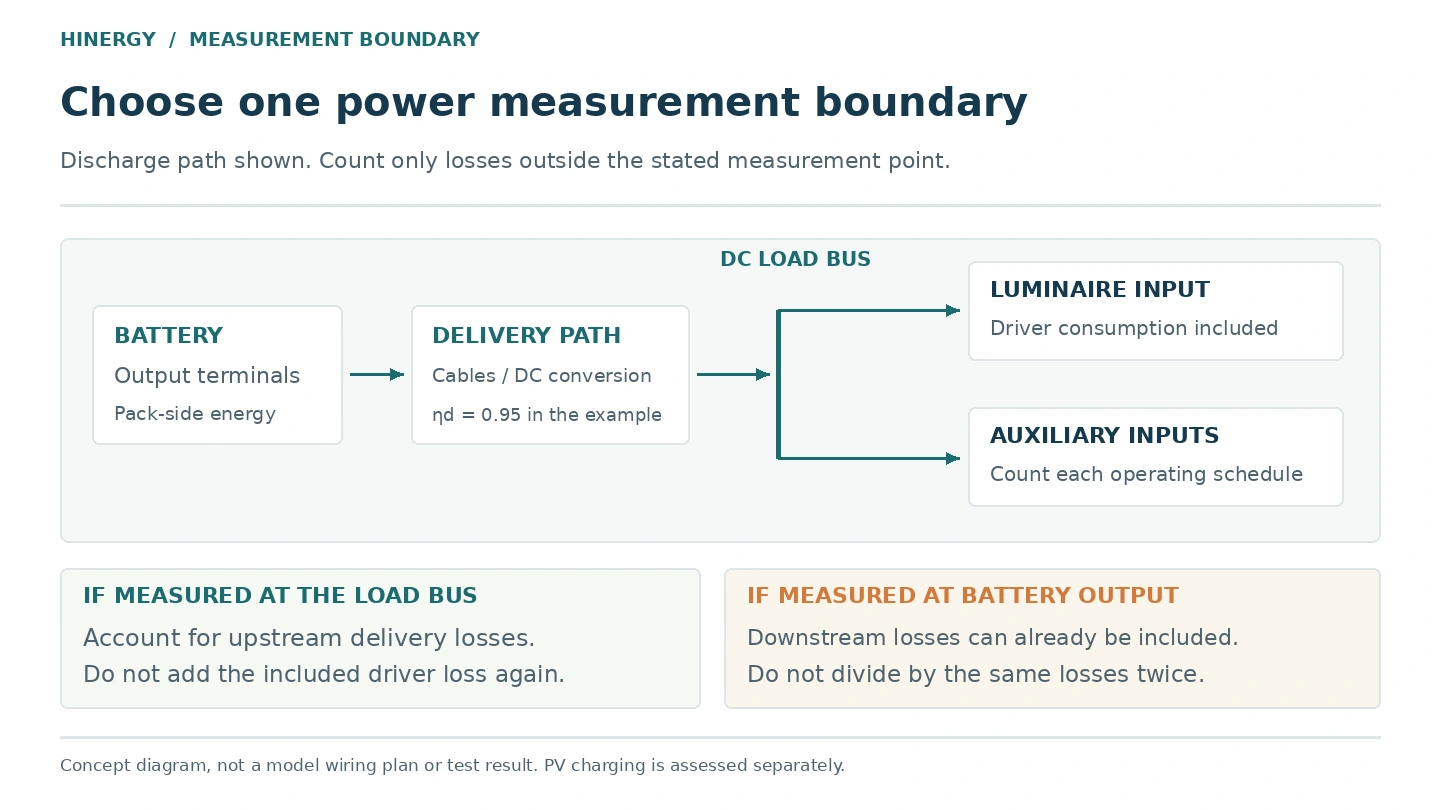
State where electrical power is measured. Luminaire input power already includes its driver’s consumption; LED-board power does not. Battery-output measurements can also include downstream wiring and conversion losses. Apply only losses outside the chosen measurement boundary, so the same driver or cable loss is not counted twice.
Calculate Energy from the Actual Dimming Schedule
Energy in Wh equals power in W multiplied by time in hours. Add all stages to obtain nightly lighting consumption. A dimming command or percentage of light output does not establish the same percentage of electrical power; request measured input power for each setting.
A hypothetical 12-hour lighting program
The following values are assumed electrical inputs at a defined DC load bus. The luminaire figures include its driver. Auxiliary equipment is represented by a separate 2 W load. This is a calculation example, not a Hinergy product specification or measured project result.
Load or operating stage | Assumed input power | Duration per 24-hour cycle | Energy |
|---|---|---|---|
Initial lighting period | 36 W | 4 h | 144 Wh |
Reduced-power lighting | 18 W | 8 h | 144 Wh |
Auxiliary equipment | 2 W | 24 h | 48 Wh |
Total system demand | — | One complete cycle | 336 Wh |
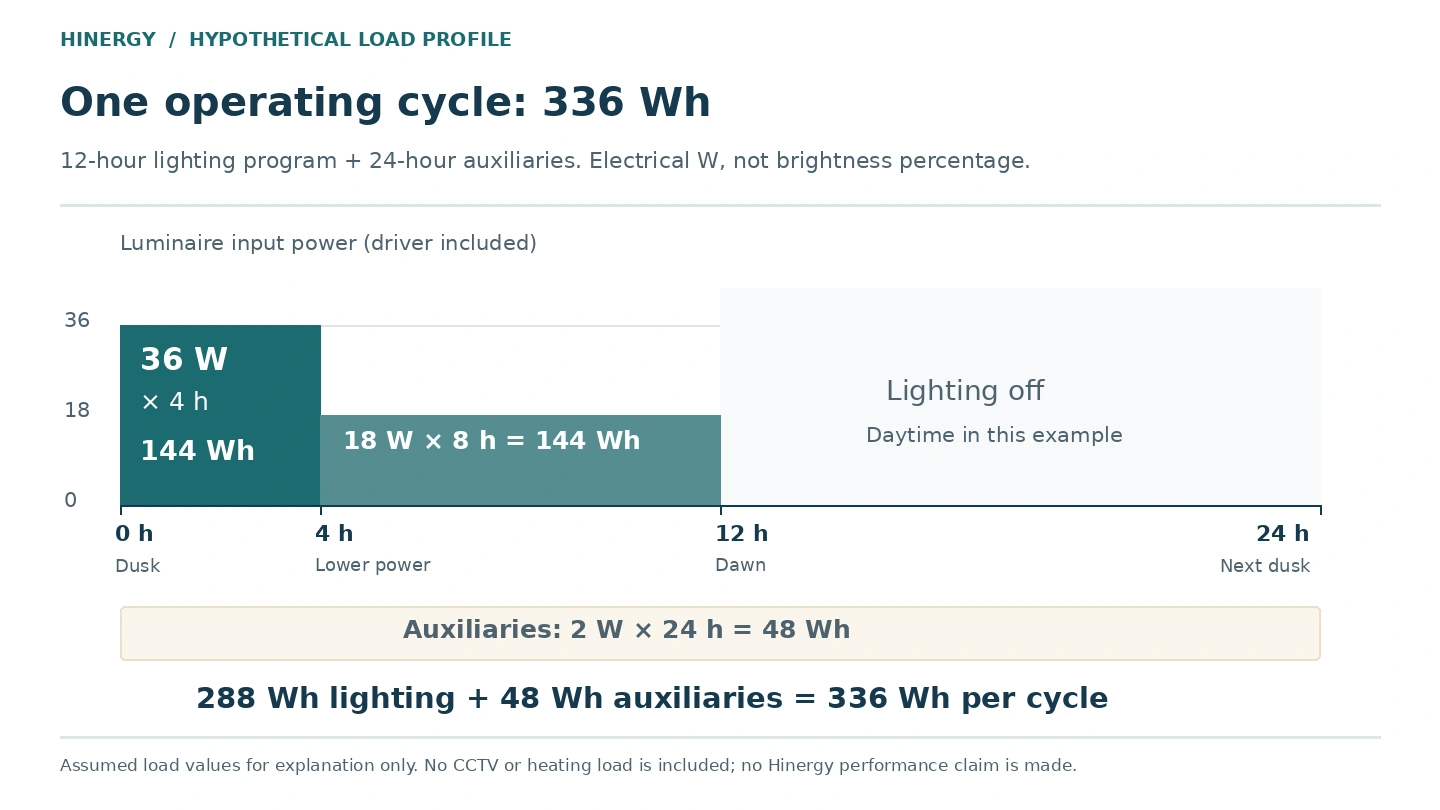
Lighting therefore uses 288 Wh; auxiliaries add 48 Wh. Constant 36 W lighting for 12 hours would use 432 Wh before auxiliaries. The difference comes from the stated electrical schedule, with lighting adequacy checked separately.
Controllers, communications, CCTV and battery heaters may operate outside lighting hours. List their actual schedules and standby demand. For a zero-solar autonomy calculation, include relevant daytime loads that the battery must supply. Camera transmission and heating can change consumption; neither is included in this example.
Define Battery Autonomy and Usable Capacity
“Two nights of backup” needs an agreed definition. Specify starting state of charge, night length, lighting program, auxiliary duty, temperature and minimum permitted charge. Zero charging and cloudy weather with partial charging are different energy scenarios.
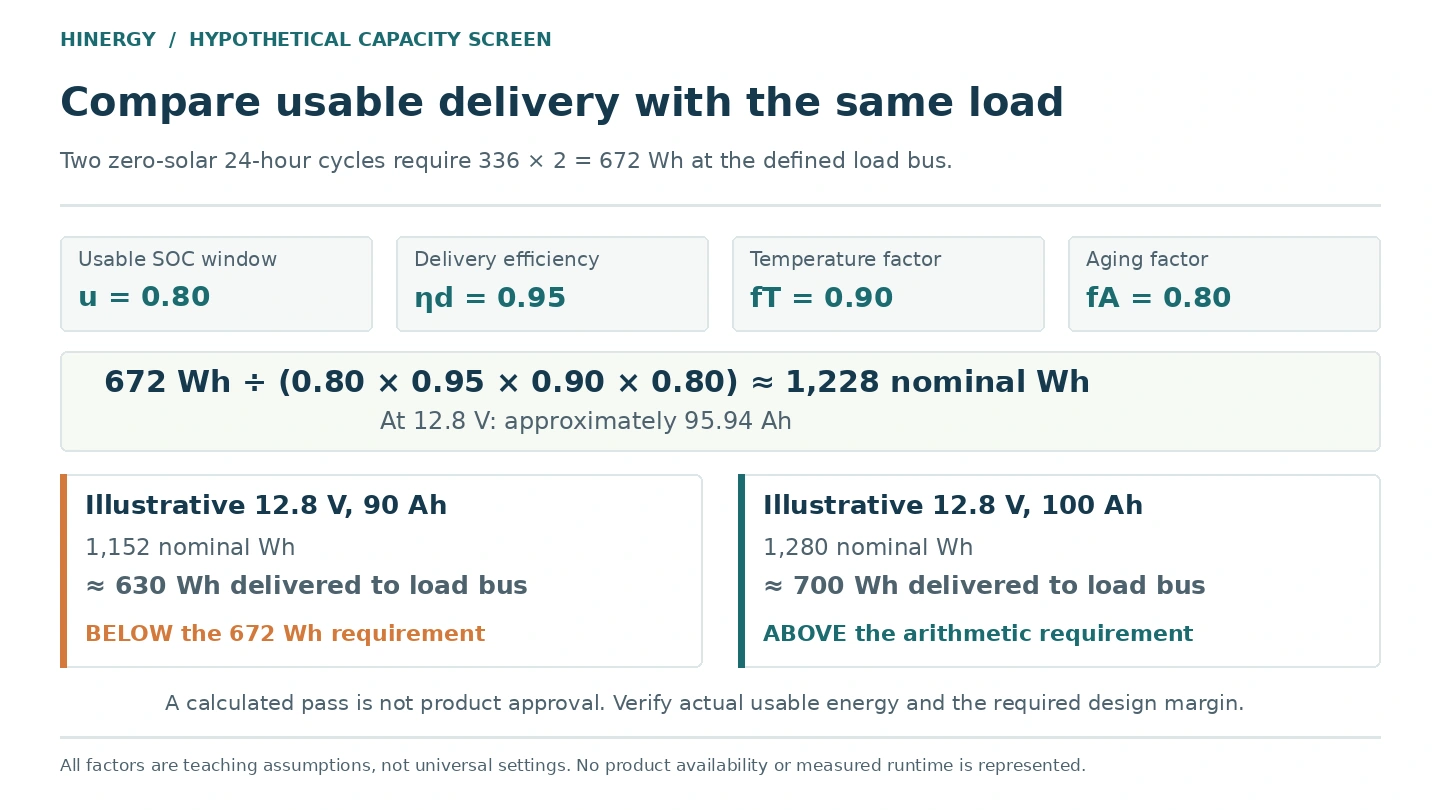
For this example, autonomy means two complete 24-hour cycles with no solar input, starting fully charged, with the same 12-hour lighting program each night. The load therefore needs 336 × 2 = 672 Wh. Two cycles are an illustrative requirement, not a universal solar street light autonomy standard.
Keep each allowance separate
Use the following preliminary model when the factors have distinct, documented meanings:
Input | Meaning | Hypothetical value |
|---|---|---|
u | Usable SOC window: 100% down to 20%; equivalent to 80% depth of discharge in this example | 0.80 |
ηd | Battery-terminal-to-load-bus delivery efficiency; excludes the driver already included in luminaire input | 0.95 |
fT | Fraction of rated energy available at the design temperature, before the SOC window is applied | 0.90 |
fA | Fraction of initial capacity retained at the agreed design-life assessment point | 0.80 |
These assumptions are not recommended settings for every lithium battery. Replace them with model-specific evidence and project requirements. Temperature and aging can interact, so this multiplication is a screening approximation. A capacity or usable-energy test that already includes a condition must not receive the same correction again.
The normal SOC operating window should also be distinguished from the BMS emergency cutoff. Protection limits alone do not establish the usable energy promised for routine operation.
Convert Required Wh into Battery Pack Ah
With the example inputs:
Convert energy to charge capacity using the actual nominal pack voltage:
A “12 V system” label is insufficient for this conversion. For example, 12.8 V × 100 Ah equals 1,280 nominal Wh; 25.6 V × 100 Ah equals 2,560 nominal Wh. Voltage compatibility must be checked separately—doubling pack voltage is not an interchangeable upgrade.
Check the candidate against the same assumptions
A hypothetical 12.8 V, 90 Ah pack contains 1,152 nominal Wh. Under the stated factors it delivers approximately 630 Wh to the load bus, below the 672 Wh requirement. A 12.8 V, 100 Ah candidate calculates to approximately 700 Wh, providing a small calculated surplus.
That 100 Ah result is a preliminary arithmetic screen, not an approved configuration or runtime guarantee. Confirm capacity tolerance, actual delivered energy, operating conditions and the project’s required margin before selecting it. Do not round a calculated minimum downward to match an available label.
Check Temperature, BMS and Installation Compatibility
When evaluating a LiFePO4 battery for a solar street light, separate discharge capacity from permission to charge. A pack may supply power at a temperature where charging is restricted. Confirm the selected cell and pack limits, temperature sensing, low-temperature protection and any heating strategy. Add heater demand to the energy calculation.
Also verify maximum continuous and transient current, the controller’s charging profile, low-voltage behavior and the driver’s input range. As voltage falls, the current required for a given electrical power can increase; a Wh calculation alone cannot establish current compatibility.
Request the exact pack identification, cell arrangement, nominal voltage and capacity-test conditions, including temperature, discharge rate and cutoff. Check enclosure space, thermal conditions, mounting and replacement access. Our all-in-one vs split solar street light comparison explains how component layout affects these choices. Construction style alone does not prove battery capacity or autonomy.
Verify Solar Charging and Recovery
A larger battery stores more energy but does not create charging energy. Solar street light battery and panel sizing must be coordinated around seasonal production, the complete load and recovery after a low-sun period.
Define the target SOC and permitted recovery time while normal loads continue. Check array orientation, shading, relevant seasonal solar data, controller limits and battery charge acceptance. An annual-average peak-sun-hours figure alone can conceal difficult operating periods. Count charging losses in the recharge calculation without duplicating discharge allowances.
The European Commission’s PVGIS guidance describes hourly off-grid energy balances and user-defined 24-hour load profiles. A street-light assessment needs the actual lighting and auxiliary profile; its default household demand and generic system assumptions should not be adopted unchanged. Inspect seasonal shortfalls and recovery behavior, not only average daily generation.
Prepare a Battery Procurement Checklist
Use the same inputs when comparing proposals from a solar street light manufacturer or supplier. The solar street light specifications checklist covers the wider system; the following items focus on storage verification.
Confirm before approval | Evidence or information to request |
|---|---|
Project and lighting duty | Location, season, lighting criteria, timed electrical loads, sensor assumptions and auxiliary schedules |
Autonomy definition | Starting SOC, no-charge or partial-charge scenario, required cycles and permitted low-SOC behavior |
Capacity calculation | Nominal and usable Wh, actual pack voltage, separate allowances and justification for design margin |
Battery and BMS identity | Pack/cell details, temperature and current limits, protection settings and agreed substitution process |
Verification and recharge | Capacity-test method and conditions, seasonal energy assessment and recovery target |
Installation and supply | Dimensions, access, connectors, quantity, delivery location, documents and model-specific commercial terms |
Specify whether low-SOC dimming is allowed and what minimum lighting service must remain. A proposal that silently changes the schedule cannot substantiate the originally requested autonomy.
Frequently Asked Questions
What size battery is needed for a 30 W, 60 W or 100 W solar street light?
There is no reliable capacity based on advertised lamp wattage alone. Use actual input W, hours at each setting, auxiliary demand, autonomy and usable-capacity conditions. Two nominally 60 W lights can require different battery sizes if their electrical schedules or installation conditions differ.
How much battery capacity is needed for 12 hours of operation?
How many backup nights should be specified for cloudy days?
How does cold weather affect solar street light lithium battery sizing?
Will a larger battery stop a solar street light switching off early?