



Do Solar Street Lights Still Charge on Cloudy Days?
Solar panels can use direct sunlight and diffuse light scattered through the atmosphere. An overcast sky can therefore support generation, although the amount varies with cloud conditions and panel exposure. The U.S. Department of Energy’s solar radiation guide explains this distinction.
However, receiving daylight does not prove that the battery receives enough charge to replace overnight consumption. Solar street lights on cloudy days may draw down stored reserves while continuing to illuminate the road. Deep shade, an obstructed panel or a temperature-related charging restriction can further limit recovery.
There is no single cloudy-weather output percentage suitable for every project. Compare expected daily energy in watt-hours (Wh), with losses and charging restrictions accounted for, against the specified nighttime demand. Panel rated power in watts is a different measurement.
Why Winter Changes Both Charging and Nighttime Demand
Shorter charging opportunities, longer operating hours
In many locations, winter reduces solar availability while extending the lighting period. A configuration suitable for a short summer evening may face a different energy balance during long winter nights.
Assess the site’s critical season rather than annual average sunshine alone. Depending on location, that may involve winter, a prolonged rainy season or persistent seasonal shading. Daylight duration alone does not establish the energy available for charging.
Cold panels and cold batteries behave differently
At comparable irradiance, cooler photovoltaic cells can operate more efficiently. This does not establish higher winter daily production: shorter days, cloud and obstruction still matter. Battery charging and usable capacity require separate checks.
Winter condition | Possible effect | What the buyer should verify |
|---|---|---|
Lower sun and longer shadows | Reduced panel exposure | Seasonal shadows from trees, buildings and nearby equipment |
Longer nights | Increased energy demand | Lighting hours and the complete output schedule |
Snow or ice | Obstruction and additional mechanical loading | Panel layout, structural suitability and maintenance access |
Low battery temperature | Restricted charging or reduced usable energy | Model-specific charging, discharge and protection limits |
For inspection and component-service procedures, see our solar street light maintenance and battery replacement guide.
What Does “Three Nights of Backup” Actually Mean?
Solar street light autonomy describes operation from stored energy under defined conditions. When an offer specifies “three nights of backup,” ask for the conditions supporting that claim before comparing it with another proposal.
Claim condition | Information to request |
|---|---|
Starting reserve | Initial stored energy, battery condition and temperature |
Usable capacity | Wh available above the protection limit, including relevant derating |
Lighting duty | Night length, output at each stage and motion-sensor assumptions |
Charging during the period | Whether the calculation assumes zero input or continued cloudy-day charging |
Auxiliary demand | Controller, communications, CCTV and any heating consumption |
End point and recovery | Minimum acceptable lighting service and the conditions needed to restore reserve |
Several nights at a reduced output are different from several nights at the originally specified lighting level. Compare solar street light battery backup against the same duty before comparing hardware. For the capacity calculation itself, see how to size a solar street light battery for the operating schedule.
Check the Energy Balance Across Several Low-Sun Days
A larger battery creates more storage space; it does not increase the energy entering the system. Review both reserve depletion and replenishment.
A hypothetical five-day example
Assume a usable energy window of 1,200 Wh above the lower protection limit, with 900 Wh available at the first dawn. Each night withdraws 300 Wh from that window. Net daytime additions are 120 Wh on two low-input days, followed by 420 Wh on three recovery days.
These are illustrative inputs, not a product specification, weather forecast or site simulation. Daytime additions are after charging losses and daytime demand; nightly withdrawals include the lighting and its nighttime electrical losses. Charging is assumed permitted, with no CCTV or heater. Temperature and ageing effects are not varied during the example.
Day | Phase | Dawn reserve (Wh) | Net daytime addition (Wh) | Night withdrawal (Wh) | Next dawn reserve (Wh) |
|---|---|---|---|---|---|
1 | Low input | 900 | 120 | 300 | 720 |
2 | Low input | 720 | 120 | 300 | 540 |
3 | Recovery | 540 | 420 | 300 | 660 |
4 | Recovery | 660 | 420 | 300 | 780 |
5 | Recovery | 780 | 420 | 300 | 900 |
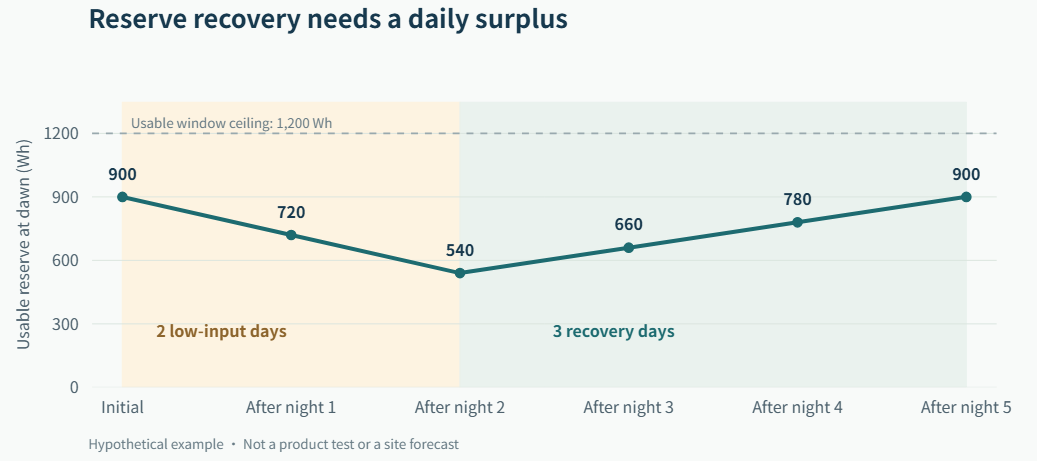
The two low-input days consume 360 Wh of reserve. Each recovery day restores 120 Wh after that night’s use, so three recovery days are needed to regain the initial dawn reserve. This does not mean the battery is fully charged.
No daytime total exceeds the assumed 1,200 Wh ceiling. A project assessment must also account for energy that cannot be stored when the battery is full, charging limits and hourly demand. The JRC’s PVGIS off-grid documentation describes time-series assessment; a road-lighting study needs the appropriate nighttime load profile and system-loss assumptions.
Can the Battery Charge in Freezing Conditions?
When comparing solar street lights for cold climates, request separate charging and discharge temperature ranges. A battery may power the LEDs at a temperature where its management system restricts charging. An overall “operating temperature” label does not answer both questions.
For example, the Victron Lithium Smart Battery manual specifies different permitted charging and discharge ranges for that battery series. Its limits are not Hinergy specifications or universal LiFePO4 limits.
Check what the protection system actually does
Ask whether temperature is measured at the battery, how charging is inhibited and when it resumes. A battery management system (BMS) that stops cold charging does not necessarily provide heating. If a heater is available, include its energy use and control settings in the winter calculation.
Do not infer below-freezing charging capability from the battery chemistry name. Confirm the selected pack and controller documentation, and retain their protection settings.
Which Design Changes Can Improve Winter Reliability?
Improve collection and usable reserve together
Check seasonal panel exposure before increasing component sizes. Where the mounting design permits, independent panel positioning can help align collection with site conditions. Our guide to all-in-one and split solar street lights explains the structural differences. Architecture alone does not prove winter performance.
Tilting a panel can influence solar collection and snow shedding, while also changing wind loading. The DOE’s winter-weather resilience guidance discusses this trade-off. Use the selected mounting arrangement and local conditions rather than one angle for every installation.
Match energy management to the lighting task
Maximum power point tracking (MPPT) concerns energy collection; programmed dimming concerns consumption. Neither creates energy. Solar street light energy management should state how output changes as available reserve changes.
For roads and industrial parks, agree the acceptable lighting schedule before selecting an energy-saving mode. Motion-controlled demand depends on activation frequency. Any enlarged panel, battery or revised bracket also needs installation compatibility checks.
When Should You Consider Another Power Arrangement?
If the proposed system repeatedly uses more energy than it can collect, additional storage alone postpones depletion. Long periods without effective charging or duties requiring uninterrupted illumination may justify another configuration, a revised location or a suitably designed backup supply.
Grid backup needs its own electrical scope and controls. Wind-solar hybrid street lighting needs a suitable wind resource, structural assessment and service arrangements. Neither should be selected from a climate label alone. There is no universal minimum-sun-hours threshold that settles every project.
What to Ask a Supplier Before Approving a Winter Configuration
For contractors, engineering procurement teams, distributors and site owners, comparable proposals start with comparable inputs. Prepare this checklist before approaching a solar street light manufacturer or supplier.
Project input | Supporting information to request |
|---|---|
Country, coordinates and critical season | Resource data and the seasonal assumptions used |
Site plan, shadows and panel position | Exposure review and proposed mounting arrangement |
Road dimensions, pole height and spacing | The agreed lighting target and output schedule |
Night length and allowed dimming | Energy demand for the complete operating program |
Minimum temperatures and battery position | Pack charging/discharge limits and protection details |
Backup and recovery expectations | Starting reserve, assumed charging and minimum service level |
CCTV, communications or heating | Combined load and any additional power arrangement |
Add quantity, destination and required documents. Distributors should retain configuration conditions for each market; owners should approve any reduced-output program. Contractors should record installed orientation and settings. Use our solar street light specification checklist to organize the remaining model documents.
Frequently Asked Questions
Can cloudy daylight fully recharge a solar street light?
It may, depending on the starting reserve, available input, charging limits and demand. Some generation under clouds does not establish a full recharge. Check the energy balance over the relevant period rather than a general cloudy-day promise.
How many nights can solar street lights run without effective charging?
Can a LiFePO4 battery charge below freezing?
Will a bigger battery solve poor winter charging?
Does automatic dimming mean full brightness all night?