




For contractors, engineering procurement teams, distributors and road or industrial-site owners, the practical question is what performance must be maintained, which parts can be renewed, and what that service will cost. Review commercial solar street lights as maintainable assets, with a documented configuration and replacement path.
What Does Solar Street Light Lifespan Actually Mean?
Separate three measures when comparing proposals:
Nightly runtime: hours of lighting under a particular charging condition and operating program.
Component life: time or duty before a battery, LED assembly or other part reaches its stated performance limit or fails.
System service life: the period during which the installation remains suitable for its intended purpose, including agreed maintenance and component renewal.
A warranty adds a contractual coverage period with its own terms. Ask whether a quoted “ten-year life” assumes the original battery remains installed, allows planned replacements, or refers only to one component. Those are different proposals.
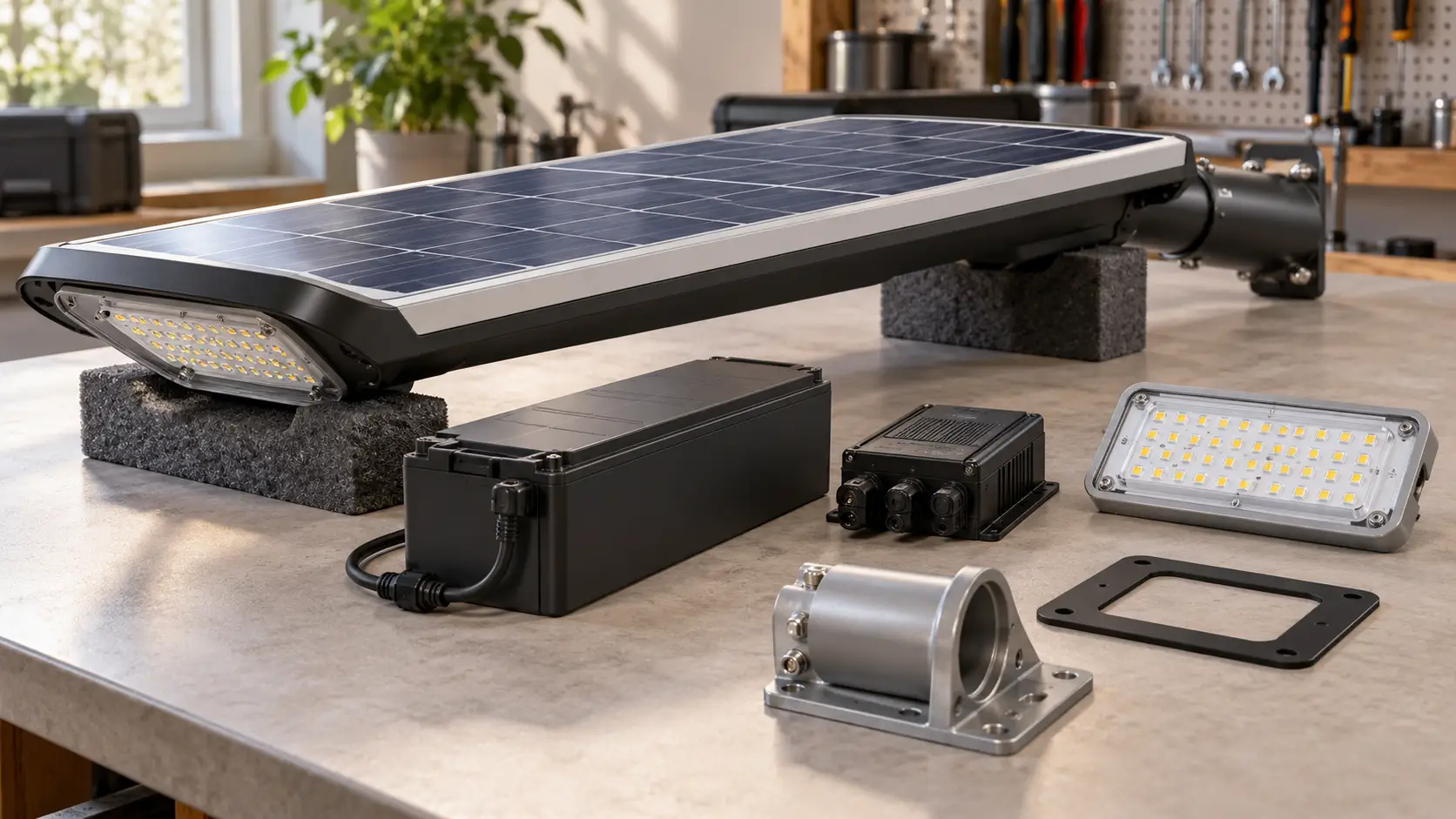
Solar Street Light Component Lifespan: What Should You Compare?
Use this table to organize the evidence. It does not prescribe replacement dates: a component may lose useful performance gradually, fail abruptly, or remain serviceable after another part is renewed.
Component | Useful life or condition indicator | Evidence to request |
|---|---|---|
Battery pack | Usable capacity and power for the required schedule | Pack identity, cycle conditions, capacity endpoint, temperature limits and protection settings |
LED assembly | Maintained light output and colour, plus functional reliability | Relevant lumen-maintenance data, operating conditions and complete-fixture information |
Solar panel | Output under comparable conditions; physical and connection integrity | Exact module specification, qualification scope and warranty terms |
Controller and driver | Stable charging, output and control functions | Electrical and thermal limits, protection details and fault records |
Seals, cables and housing | Continued enclosure and connection integrity | Materials, interfaces, inspection findings and service instructions |
Pole, brackets and foundation | Structural suitability and condition | Approved design, corrosion protection and inspection records |
How Long Do Solar Street Light Batteries Last?
A defensible battery replacement interval starts with the specific pack and duty. Ask the supplier to support any proposed year range with the battery identity, test conditions and expected operating environment. Chemistry alone cannot establish a fixed number of years for every solar street light battery.
Battery Cycle Life vs Calendar Life
Cycle life describes endurance under a defined charge/discharge test. Calendar ageing occurs with elapsed time and storage or operating conditions, even when few cycles are completed. Both matter outdoors; dividing a laboratory cycle count by 365 does not establish field service life.
For a concrete example of specification format, the Victron Lithium Smart technical data lists 2,500 cycles at 80% depth of discharge and 5,000 at 50%, using a capacity endpoint of at least 80% of nominal. These are that manufacturer's product data, not Hinergy specifications, street-light replacement intervals or a recommendation to use that battery in a light.
The example shows why the conditions belong beside the number. Also confirm test temperature, charge/discharge rate and cycle definition. An endurance endpoint such as 80% remaining capacity is not automatically the point at which every project must replace its battery.
Temperature, Discharge Depth and Charging Conditions
LiFePO4 battery life for solar street lights needs assessment against the actual temperature history, daily discharge, charging limits and protection behaviour. Include storage before commissioning. Check the approved charge and discharge temperature ranges separately; cold-weather capacity and charging restrictions are different considerations.
Review whether the panel and operating program can support the required service as capacity changes. Frequent low-energy cutoffs warrant investigation, but do not identify the cause by themselves. Our solar street light battery sizing guide explains the relationship between the nightly schedule and usable storage.
Cell Data vs Battery Pack Performance
Confirm whether the quoted endurance belongs to an individual cell or the assembled pack. Connections, cell consistency, protection electronics, enclosure temperature and controller compatibility also matter. Request evidence that identifies the supplied configuration, and confirm how a compatible replacement pack would be obtained later.
Does an LED Hour Rating Describe the Whole Luminaire?
Solar LED street light lifespan is often advertised in operating hours. Read the accompanying criterion: L70 concerns light output declining to 70% of its initial level; L80 uses 80%. Neither means every part of the solar lighting system will remain functional until that hour.
LM-80 measurements and TM-21 projections concern LED light-source maintenance under specified conditions. The NGLIA/LSRC luminaire lifetime guide hosted by DOE distinguishes that information from complete-luminaire reliability. Drivers, optical parts, connections and seals introduce additional failure or degradation mechanisms.
Check that the offered LED data relate to relevant current and temperature conditions. Then assess the complete fixture and maintained lighting outcome. The wattage and lumens guide explains the distinction between fixture output and illumination delivered to the road.
What About the Panel, Controller, Seals and Pole?
Solar panel service life should be reviewed using the exact module and its environment. A long performance warranty for another module does not establish the output or durability of a compact street-light panel. The IEC 61215-1 public overview explicitly explains that qualification results do not quantitatively predict module lifetime.
Solar street light controller lifespan and driver reliability need their own evidence. Review thermal conditions, electrical limits, moisture protection and fault history. MPPT describes a charging-control approach; it does not, by itself, prove a particular service life.
Inspect enclosure joints, gaskets, cable entries and connectors over time, including after service. An ingress rating is not a guarantee of unchanged protection throughout the asset's life. Assess pole, bracket and foundation condition separately through the applicable structural inspection arrangements.
Investigate Shorter Runtime Before Declaring Battery End of Life
Reduced overnight operation can reflect capacity decline, but also shading, dirty panels, charging faults, changed settings, extra loads, temperature or connection problems. Compare observations under relevant conditions with the original operating program. A single low voltage reading cannot establish remaining battery capacity.
Retain commissioning records as a baseline: model, location, settings, test conditions and initial performance. The installation and commissioning guide explains those records. Use the model's diagnostic procedure and the maintenance and battery replacement guide for service planning.
When Should You Repair, Replace a Component or Renew the System?
Choose an action against the required remaining service, not age alone. First identify the cause, check the condition of the rest of the installation, and confirm whether a compatible repair restores the agreed function.
Situation | Confirm before deciding | Possible direction |
|---|---|---|
Runtime changed after shading or settings changed | Charging conditions, loads and approved operating program | Correct the verified cause and reassess performance |
A degraded component is confirmed | Remaining system condition, compatibility and replacement access | Replace the component and verify operation |
Several parts are degraded or support is unavailable | Repair scope, parts availability and remaining performance needs | Compare refurbishment with fixture or system renewal |
Structural damage or significant corrosion is found | Assessment by the responsible competent professional | Resolve structural suitability before continued service |
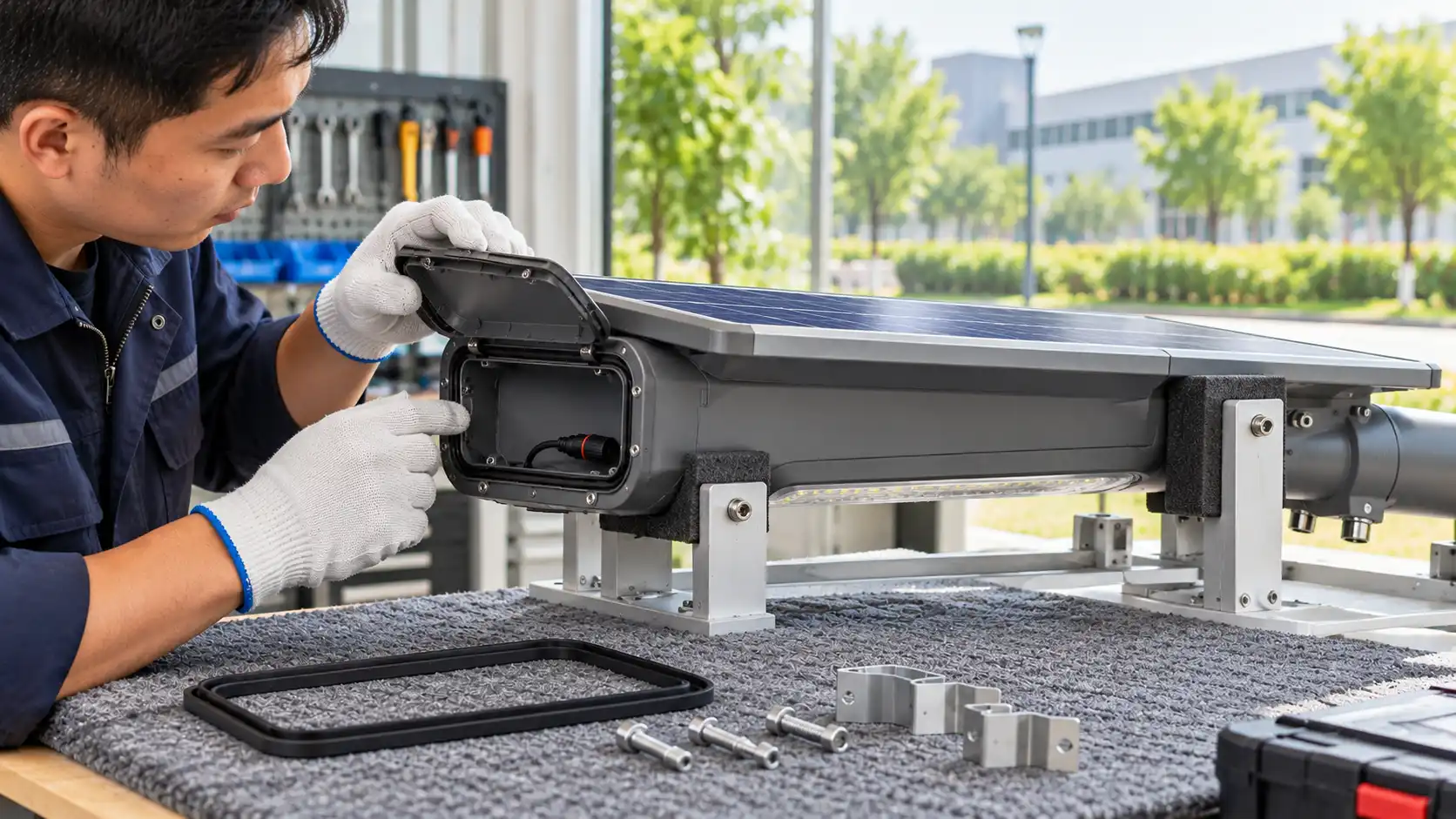
For an integrated solar street light, verify the actual battery and electronics access rather than assuming the entire unit must always be discarded. Restoration of seals, mounting and settings belongs in the repair scope. A new battery will not correct an unresolved charging or enclosure fault.
Compare Lifespan Claims, Warranty and Lifecycle Cost
Give each solar street light manufacturer or supplier the same location, operating schedule, service objective and documentation request. Use these questions to compare proposals on a consistent basis.
Claim or commitment | Evidence to request | Boundary to clarify |
|---|---|---|
Stated system life | Exact configuration, performance endpoint and supporting basis | Original components or planned renewals? |
Battery cycle or year claim | Applicable cell/pack data and operating assumptions | Remaining capacity, duty and environment? |
LED hour claim | Criterion, relevant data and fixture conditions | Light-source maintenance or luminaire reliability? |
Warranty | Written coverage, exclusions and claim process | Parts, labour, freight and access costs? |
Long-term support | Service instructions and replacement arrangements | Availability, compatibility and commercial terms? |
A solar street light lifecycle cost comparison should use a stated study period and explicit replacement assumptions. Include parts, inspection, labour, lifting/access, transport and relevant service interruptions. Test alternative replacement scenarios rather than presenting one assumed year as a prediction. The solar street light quote guide covers supply scope and exclusions.
Project Information to Prepare for a Service-Life Review
Installation location, temperature exposure, dust, moisture and corrosion conditions.
Required lighting performance, nightly program, additional loads and low-sun reserve objective.
Service period being evaluated and maintenance/access arrangements.
Exact equipment configuration and available test or warranty documents.
For existing assets: installation dates, settings, faults, repairs and performance observations.
Ask for a component replacement plan alongside the proposed configuration. Keep original-part service history separate from the total service period of a maintained asset.
Frequently Asked Questions
How Long Do Solar Street Lights Last?
Review component life and the maintained system separately. A serviceable installation can continue after individual parts are renewed. A meaningful year claim needs a defined configuration, environment, performance requirement and maintenance assumption.
How Many Years Does a LiFePO4 Solar Street Light Battery Last?
Does a 50,000-Hour LED Rating Mean a 50,000-Hour System Life?
Can Replacing the Battery Extend an Integrated Solar Street Light's Life?
Is a Longer Warranty Proof of a Longer Lifespan?
Why Does a Solar Street Light Stop Lasting Through the Night?