



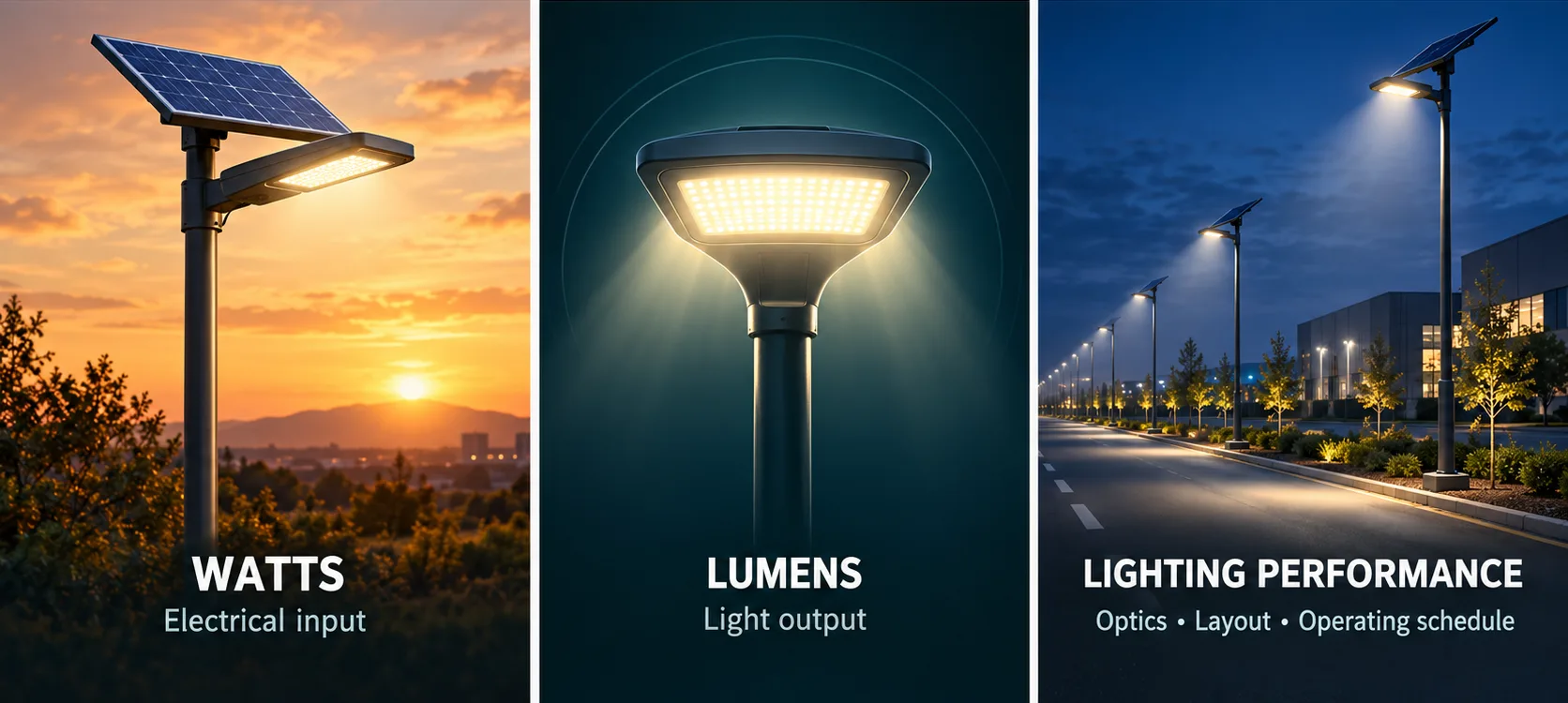
For contractors, engineering procurement teams, distributors and site owners, the useful question is: which configuration delivers the required lighting service, with evidence that can be checked before purchase?
Solar Street Light Wattage vs. Lumens: The Key Measurements
A solar street light contains several components with different ratings. The panel's rated power, battery energy and luminaire input power answer separate questions. Keep them separate when reviewing a datasheet.
Figure | What it describes | What the buyer should check |
|---|---|---|
Luminaire input power, W | Electrical power consumed at the stated measurement point | Output setting, input conditions and whether driver or auxiliary power is included |
Luminous flux, lm | Light output from the specified luminaire | Complete fixture, optical variant and test conditions |
Illuminance, lx | Incident light per unit area on a surface | Required locations, calculation plane and installed layout |
Luminous efficacy, lm/W | Light output divided by the corresponding power input | Matching measurement boundaries and operating conditions |
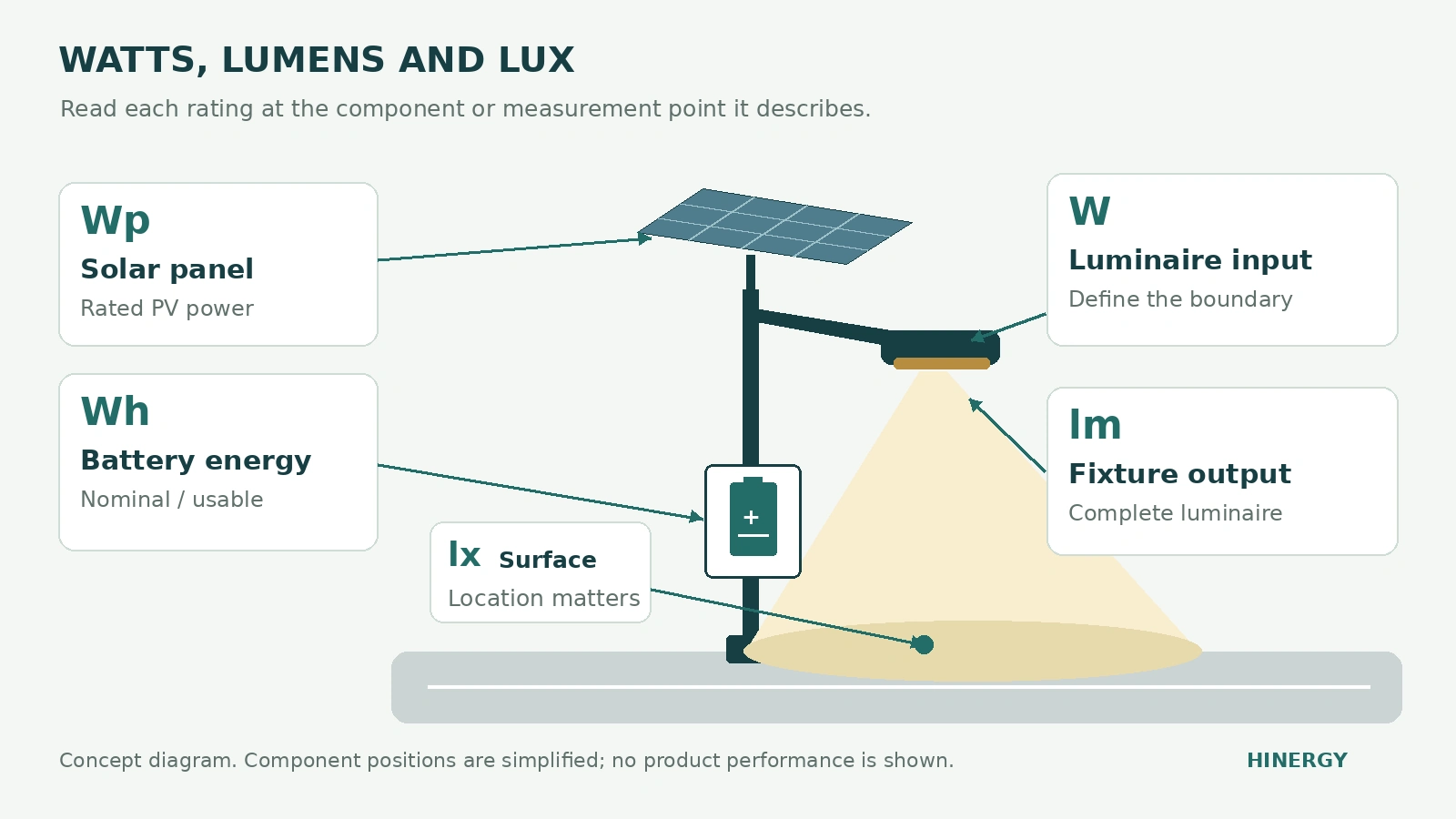
The CIE definition of lux relates illuminance to light arriving at a surface. A fixture's total lumens therefore need a distribution and installation context before they tell you about road illumination. Watt-hours, meanwhile, describe energy over time: use them when assessing nighttime consumption and battery storage.
Check Real Luminaire Power and Measured Light Output
When comparing commercial solar street lights, establish what the wattage label represents. It could describe luminaire input, an LED component rating, a replacement claim or another declared value. Ask the supplier to identify the rating and its measurement point.
A 60W solar street light proposal should state the actual input at the offered output setting. Also request the luminaire's measured light output, optical configuration, input conditions and relevant temperature conditions. LED-chip lumens do not account for the complete fixture's optical and thermal behavior.
The official IES optical and electrical measurement guidance covers measurements including flux, electrical power, efficacy and intensity distribution. Request appropriate test records identifying the proposed configuration. If the quotation, report and photometric file describe different variants, resolve that difference before approval. Our solar street light specification checklist explains the wider document review.
Compare Lumens per Watt at the Same Operating Point
Solar street light lumens per watt can help compare the power needed for a given light output. The CIE definition of luminous efficacy also requires clarity about auxiliary power included in the measurement.
Consider two hypothetical luminaires tested on a comparable basis, each producing 6,000 lumens. Assume the same measurement boundary, including the driver, with comparable color and temperature conditions.
Hypothetical luminaire | Input power | Measured light output | Calculated efficacy |
|---|---|---|---|
A | 40 W | 6,000 lm | 150 lm/W |
B | 60 W | 6,000 lm | 100 lm/W |
Choose Output for Roads and Parking Lots
Roads: define the task before choosing a wattage
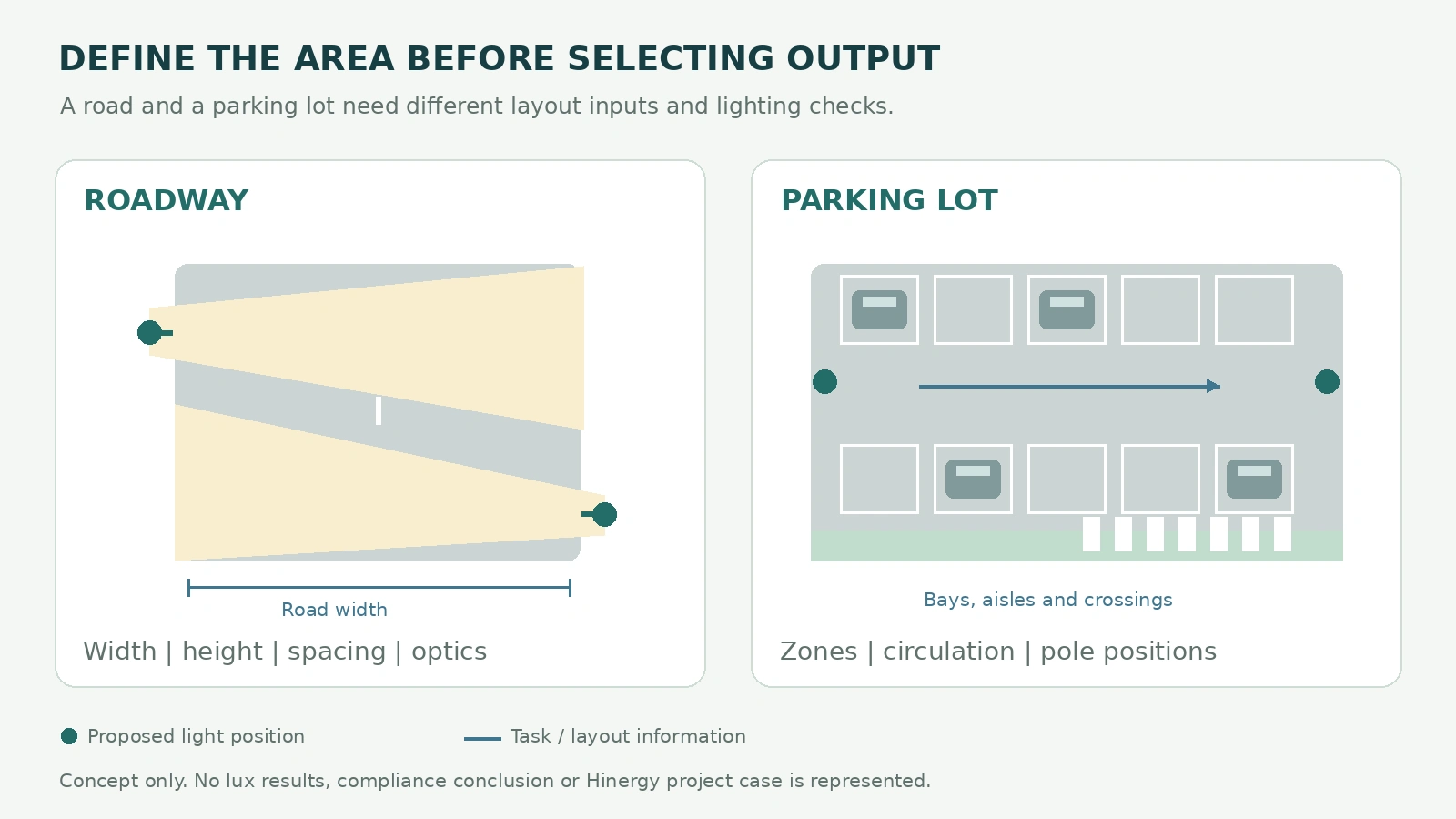
Record road width, road use, crossings and pedestrian activity, then agree the applicable lighting criteria with the designer or approving authority. Depending on the project, assessment may involve illuminance or road luminance, alongside uniformity and glare requirements.
When shortlisting 20W, 30W, 60W or 100W solar street lights, compare documented operating points against that brief. A wattage-to-road-width chart cannot establish suitability without the optics and installation geometry. A wider road may require a different arrangement, rather than simply a larger lamp.
How many watts do solar parking lot lights need?
Start with a site plan showing parking bays, vehicle aisles, entrances and walking routes. Existing pole locations, nearby buildings and trees affect both light distribution and solar exposure. Identify any additional visibility task, such as pedestrians at a crossing or activity near an entrance.
For solar parking lot lighting, compare candidate luminaires through a layout calculation. Different zones may need different optics, quantities or operating programs. A single wattage selected from the total site area can leave important locations poorly served.
Target area | Information to provide | Result to verify |
|---|---|---|
Roadway | Road profile, pole positions and adopted lighting criteria | Required lighting levels, uniformity and glare performance |
Parking bays and aisles | Bay layout, vehicle circulation and available mounting positions | Coverage of the assessed areas under the approved program |
Entrances and pedestrian routes | Crossings, obstacles and relevant visibility tasks | Lighting at the locations and orientations that matter |
Verify the Layout Before Increasing Wattage
Request IES or LDT photometric data matching the proposed model, optic and output setting. A lighting calculation should state mounting height, spacing, aiming, assessment areas and maintenance assumptions. Our pole height and spacing guide explains these layout inputs.
Read the results against all applicable criteria. A satisfactory average alone can conceal dark locations; uniformity and glare require their own checks. The IES roadway and parking facilities guidance addresses these applications as design tasks. Confirm the requirements adopted for your project rather than borrowing an unrelated lux target.
Include required dimmed stages in the assessment. If a quotation changes the optic, output or pole arrangement, check whether the calculation still represents the offered installation.
Check That the System Can Sustain the Lighting Program
Solar street light power consumption depends on the actual operating schedule. Record input watts and duration at each stage. Include controller, communications, CCTV or heating demand wherever it falls outside the loads already counted. A "50% brightness" command does not establish a measured 50% reduction in electrical power.
For the storage calculation, see how to size a battery for the lighting schedule. Check charging and recovery under the relevant season as well; our guide to cloudy-day and winter operation explains those conditions. Agree how low-energy control modes may change the lighting service before accepting an all-night runtime claim.
What to Request Before Approving a Solar Street Light Quote
Give each solar street light manufacturer or supplier the same project brief. Ask for:
Location, site plan, lighting criteria and proposed mounting arrangement.
Exact luminaire model, optical variant and output setting.
Input power, measured lumens and their test conditions.
Matching photometric data and the project lighting calculation.
Nightly operating stages, sensor assumptions and additional loads.
Seasonal energy, usable storage, reserve and recovery assumptions.
Quantity, delivery destination, supply scope and required documents.
Contractors need installation and acceptance information; engineering procurement teams need traceable configuration records. Distributors should retain the assumptions behind each offered model, while owners should approve operating modes and lighting outcomes. Compare quotations on that shared basis. The guide to what a solar street light quote includes covers commercial scope and exclusions.
Frequently Asked Questions
Is a 100W solar street light always brighter than a 60W model?
Compare actual input and measured fixture lumens first. Two models can have different efficacies and distributions. Higher total lumens also do not establish better illumination at every road location. Review both fixtures in the proposed layout.
How many lumens do solar street lights need?
What is the brightest solar street light for a parking lot?
What does a "300W" solar street light label actually describe?
Can I calculate road lux from lumens alone?